Off-Grid Solar Systems for Homes, Farms and Cabins: Get Free Quotes
Free quotes from solar installers across South Africa. One request, no obligation.
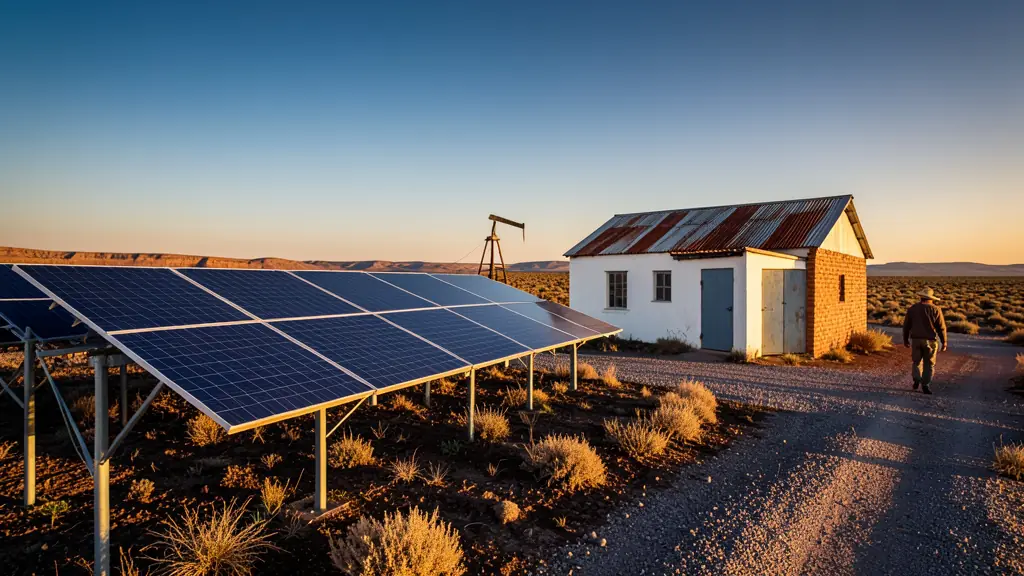
An off-grid solar system supplies all of a property's electricity from panels and batteries, with no connection to the municipal or Eskom grid. It suits farms, game lodges, holiday cabins and plots where a grid connection is far away or not allowed. SolarPanel.co.za is a free quote service. One form goes to independent installers and suppliers who work in your area, and they quote you directly. We do not design, sell or install systems ourselves, and there is no fee or obligation.
How an off-grid system is built
Because there is no grid to fall back on, an off-grid system must carry the whole load on its own. It has four main parts:
- Panels: sized to cover your daily energy use, even in winter or on cloudy days.
- Charge controller or inverter-charger: manages how the panels charge the batteries. See solar charge controllers.
- Battery bank: stores enough energy to last through the night and through a few cloudy days.
- Off-grid inverter: turns battery power into household current, and must handle motor start-up surges.
Many properties add a backup generator that starts automatically when the batteries run low, which allows a smaller battery bank than a fully solar design.
Sizing the array, batteries and inverter
Off-grid sizing starts by listing every appliance, its power in watts, and how many hours a day it runs. Installers add these up to a daily kWh figure, then divide by the peak sun hours for your region, allowing for losses. The Northern Cape and Karoo get far more sunshine than the Cape south coast or the Garden Route, which changes the array size needed for the same load.
Batteries are sized by the energy you need overnight and the number of cloudy days you want covered. Lithium iron phosphate (LiFePO4) batteries tolerate deep daily cycling better than lead-acid and are common today, while lead-acid or gel batteries still appear in lower-cost designs. Inverter size depends on the largest motor you will start, such as a borehole pump or a compressor. Our solar calculator gives a starting point.
Siting, safety and legal points
Choose a shaded, ventilated spot for the batteries, away from rodents and dust, and place ground-mount frames clear of grass fires and livestock. In coastal areas, ask about corrosion-resistant fittings. Wind and hail loads matter on open sites, so ask installers how the frames are anchored and rated.
Even without a grid connection, the wiring still has to follow SANS 10142-1, and PV work falls under SANS 10142-1-2. A registered electrician should issue an Electrical Certificate of Compliance, which insurers often ask for. If the property might connect to the grid later, ask whether the inverter can be upgraded. Where a farm needs bigger loads, see farm solar systems too.
Off-grid system price and what drives it
People search for off grid solar system price and complete packages, but no fair figure exists without your load list and location. Quotes differ because of:
- The daily energy use and the largest single load.
- Battery capacity, chemistry and expected cycle life.
- The array size and mounting, roof or ground.
- A backup generator and automatic start controls.
- The distance from the array to the batteries and house.
- Transport to remote sites and installer travel time.
Compare packages by what they actually include, and ask what happens after a run of cloudy days.
What to include in your request
- List every appliance and how long it runs each day.
- Say which is the largest motor to start, such as a pump.
- Describe the site: roof, open ground, coast or inland.
- State how many cloudy days of storage you want.
- Mention if a generator already exists and its size.
Off-Grid Solar Systems at different properties
- Family homes: rarely fully off-grid, though some owners go grid-free with large battery banks and a generator
- Estate homes: occasional off-grid homes where the estate allows it, with ground or roof panels and generous storage
- Townhouses and flats: seldom suitable for townhouses, though off-grid common-area lighting or gate systems are sometimes installed
- Farms, smallholdings and lodges: farmhouses, labour housing and lodges far from the grid, often powered with a generator backup
- Shops, offices and schools: remote shops, guest lodges and rural clinics that need steady power where the grid is unreliable
- Factories and warehouses: mines, remote sheds and pump stations running on dedicated solar, battery and generator systems
Frequently asked questions
Does SolarPanel.co.za supply off-grid solar packages?
What is the difference between off-grid and hybrid?
Can an off-grid system run a borehole pump or air conditioner?
How long do off-grid batteries last?
Off-Grid Solar Systems by province and city
- Johannesburg
- Pretoria
- Centurion
- Midrand
- Sandton
- Randburg
- Roodepoort
- Krugersdorp
- Randfontein
- Germiston
- Boksburg
- Benoni
- Kempton Park
- Alberton
- Vanderbijlpark
- Vereeniging
- eMalahleni (Witbank)
- Middelburg
- Secunda
- Mbombela (Nelspruit)
- Rustenburg
- Brits
- Klerksdorp
- Potchefstroom
- Polokwane
- Tzaneen
- Lephalale
- Kimberley
- Kathu
- Upington
- Bloemfontein
- Welkom
- Sasolburg
- Durban
- Pinetown
- Pietermaritzburg
- Richards Bay
- Newcastle
- Ladysmith
- Gqeberha (Port Elizabeth)
- East London
- Kariega (Uitenhage)
- Cape Town
- Bellville
- Paarl
- Stellenbosch
- George
- Worcester
More solar products and services
Solar panels & mounting
Solar power systems
Inverters & batteries
Solar geysers & pool heating
Solar pumps & lights
Get free solar quotes
Tell us what you need and where. An installer or supplier who works in your area quotes you directly. Free, no obligation.
Size it roughly (optional)
Tick what must keep running when the power is off. The estimate goes into your request so installers can quote closer to what you need.
5.0 kWh per kWp a day
Tick a few loads or enter your monthly units to see a size.
A rough guide only. An installer confirms the size after looking at your bill, roof and distribution board.