Get Free Hybrid Inverter Quotes from Suppliers Near You
Free quotes from solar suppliers and installers across South Africa. One request, no obligation.
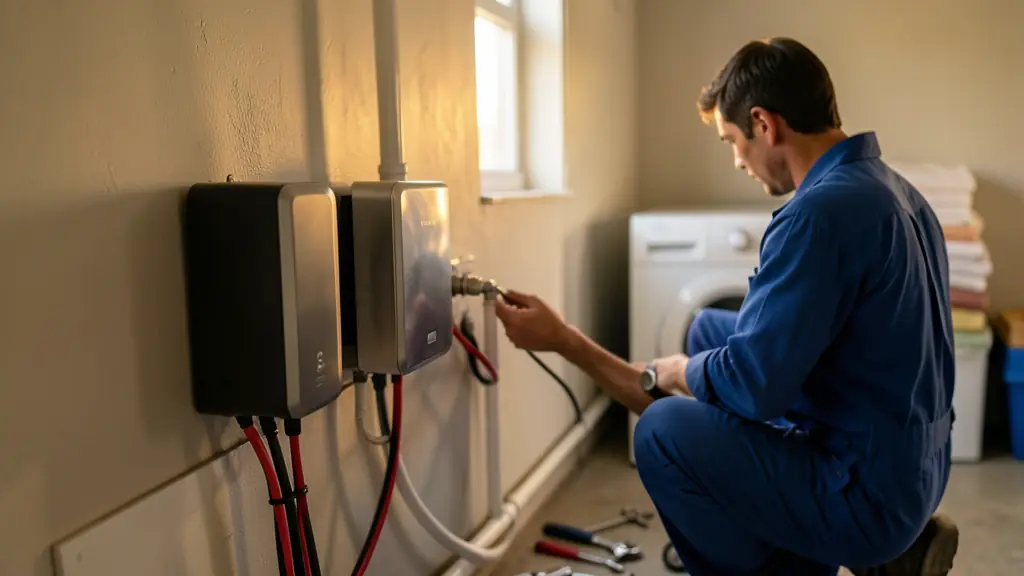
A hybrid inverter manages your solar panels, your batteries and the grid in one box, so the house keeps running during load-shedding and uses the sun first. It is the core of most modern home backup systems. SolarPanel.co.za is a free quote service. Fill in one form and we pass your request to independent suppliers and installers in your area, who quote directly. We do not sell, supply or install anything ourselves, and there is no fee or obligation.
How a hybrid inverter works
A hybrid inverter combines a solar charge controller, a battery charger and a grid-connected inverter. Power from the panels runs the house first, extra power charges the batteries, and any remaining power may be exported if your municipality allows it. When the grid goes down, the inverter switches to battery power, usually within a fraction of a second, and feeds an essential-loads circuit.
That backup circuit is important. Most homes do not back up everything, but just lights, plugs, Wi-Fi, a fridge and perhaps a TV. Heavy loads such as stoves and geysers are normally left off it. For a whole-system view see hybrid solar systems.
Choosing a hybrid inverter: 5 kW, 8 kW and phases
Home hybrid inverters are often sold as 5 kW, 8 kW or larger units. The right size depends on the loads you want to run at once and any motor surge. Check the following:
- Single or three phase: match your supply, and ask whether a three-phase unit backs up all phases.
- Battery voltage and chemistry: low-voltage or high-voltage, and whether it communicates with your lithium battery.
- Solar input: the maximum panel power and number of MPPT inputs.
- Parallel capability: lets you add a second unit later.
Pair it with suitable storage from our page on lithium solar batteries.
Approvals, registration and installation
A hybrid inverter that can export to the grid counts as embedded generation. It should be NRS 097-2-1 compliant and on the approved list of your municipality or Eskom, and the system needs SSEG registration before it is connected. Some municipalities require approval even if you never plan to export. The wiring must meet SANS 10142-1 and SANS 10142-1-2, and a registered electrician should issue the Electrical Certificate of Compliance (CoC). Look for installers who hold SAPVIA PV GreenCard training, and tell your insurer.
Hybrid inverter price: what affects it
We do not publish prices, because a hybrid inverter quote changes with the specification. Suppliers will look at:
- Power rating and single or three-phase design.
- Number of solar inputs and maximum battery capacity.
- Backup switching speed and surge capacity.
- Monitoring app, communication ports and brand support in South Africa.
- Warranty period and replacement terms.
- Installation, isolators, surge protection, cabling and the CoC.
Compare what is included in each quote, not just the headline number. If you are not sure of the size, the solar calculator is a good starting point.
What to include in your request
- State your phase and the essential loads to back up
- Say if you already own panels or batteries
- Mention the battery size you plan to use
- Ask whether the inverter is on your municipality's list
- Ask what warranty and local support come with it
Hybrid Inverters at different properties
- Family homes: a single-phase hybrid unit keeping lights, internet and the fridge on through load-shedding
- Estate homes: a larger hybrid inverter with a neat wall-mounted battery, installed to estate and municipal rules
- Townhouses and flats: a compact hybrid inverter for essentials, with body corporate approval and tidy cable runs
- Farms, smallholdings and lodges: a hybrid inverter pairing panels, a generator input and batteries for homesteads and workshops
- Shops, offices and schools: a hybrid inverter keeping tills, servers and lighting running while solar covers daytime load
- Factories and warehouses: parallel three-phase hybrid units supporting critical loads such as controls and cold-room compressors
Frequently asked questions
Do you supply hybrid inverters yourselves?
Will a hybrid inverter keep my whole house running in load-shedding?
Can I add batteries to a hybrid inverter later?
Does a hybrid inverter need SSEG registration?
Hybrid Inverters by province and city
- Johannesburg
- Pretoria
- Centurion
- Midrand
- Sandton
- Randburg
- Roodepoort
- Krugersdorp
- Randfontein
- Germiston
- Boksburg
- Benoni
- Kempton Park
- Alberton
- Vanderbijlpark
- Vereeniging
- eMalahleni (Witbank)
- Middelburg
- Secunda
- Mbombela (Nelspruit)
- Rustenburg
- Brits
- Klerksdorp
- Potchefstroom
- Polokwane
- Tzaneen
- Lephalale
- Kimberley
- Kathu
- Upington
- Bloemfontein
- Welkom
- Sasolburg
- Durban
- Pinetown
- Pietermaritzburg
- Richards Bay
- Newcastle
- Ladysmith
- Gqeberha (Port Elizabeth)
- East London
- Kariega (Uitenhage)
- Cape Town
- Bellville
- Paarl
- Stellenbosch
- George
- Worcester
More solar products and services
Solar panels & mounting
Solar power systems
Inverters & batteries
Solar geysers & pool heating
Solar pumps & lights
Get free solar quotes
Tell us what you need and where. An installer or supplier who works in your area quotes you directly. Free, no obligation.
Size it roughly (optional)
Tick what must keep running when the power is off. The estimate goes into your request so installers can quote closer to what you need.
5.0 kWh per kWp a day
Tick a few loads or enter your monthly units to see a size.
A rough guide only. An installer confirms the size after looking at your bill, roof and distribution board.