Grid-Tied Solar Systems in South Africa: Free Quotes and Registration Help
Free quotes from solar installers across South Africa. One request, no obligation.
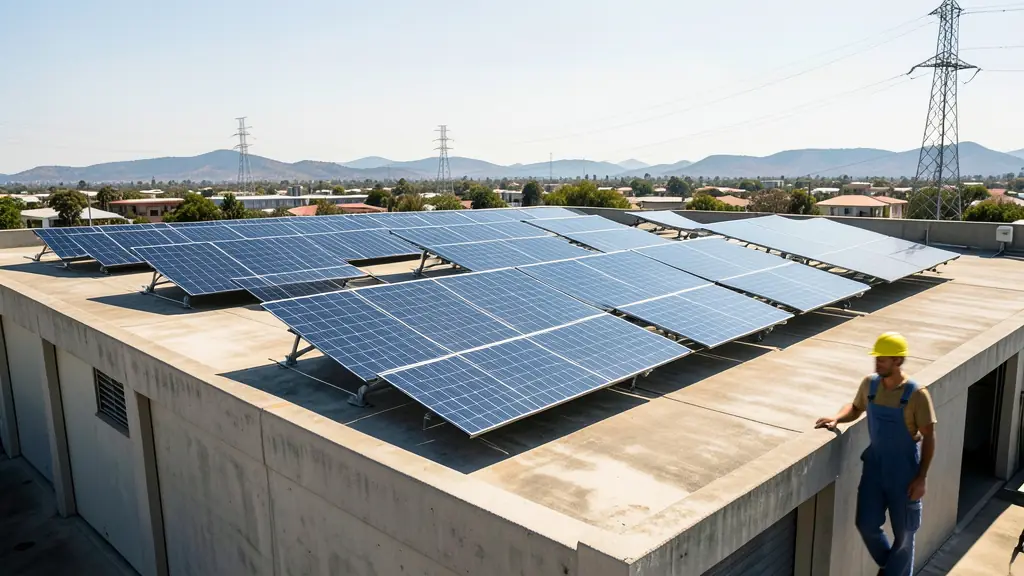
A grid-tied solar system feeds the electricity from your panels straight into your building and the grid, so the sun reduces what you draw from Eskom or your municipality. It has no batteries, which keeps the setup simpler, but it also switches off when the grid fails. SolarPanel.co.za is a free quote service. You send one form and independent installers in your area quote you directly. We do not sell or install anything ourselves, and there is no fee or obligation.
How a grid-tied system works
Panels produce direct current, and a grid-tied inverter converts it to alternating current that matches the grid's voltage and frequency. Your appliances use the solar power first, and the grid supplies whatever the panels cannot. If the system makes more than you use, the extra can flow back into the grid, where the municipality allows it.
For safety, a grid-tied inverter shuts down automatically when the grid goes off, so linemen working on the network are not put at risk. This is why a grid-tied system gives no backup during load-shedding. If outages are the problem, look at hybrid solar systems or backup power systems. Grid-tied suits properties that use most of their electricity in the daytime.
Is it legal? SSEG registration and Eskom rules
A common search is whether solar panels are legal with Eskom. Solar is legal, but grid-tied systems must be registered. Your municipality or Eskom requires small-scale embedded generation (SSEG) approval before you connect, and the inverter must comply with NRS 097-2-1 and be on the approved list. Skipping registration can bring fines, disconnection and problems with insurance.
Some municipalities offer feed-in credits or net-billing arrangements, while others only allow export-limited or zero-export systems. Rules differ from one area to the next, so ask your installer which applies to you. The system must be wired to SANS 10142-1 and SANS 10142-1-2, and a registered electrician issues the Electrical Certificate of Compliance. See solar compliance and registration for more.
Who a grid-tied system suits
Because there are no batteries, the economics rely on using the solar power as it is made. That makes grid-tied systems popular with businesses, schools, factories and warehouses, and with homes where someone is in during the day. Households that are out all day may export more, which only pays off if the municipality credits it.
- Daytime-heavy loads such as air conditioning, refrigeration and machinery.
- Flat or north-facing roofs with little shade.
- Properties where outages are rare or where a generator already covers them.
You can often add batteries later by swapping to a hybrid inverter, so ask installers whether their design leaves room for that. Larger commercial jobs are covered under commercial solar.
What affects the price of a grid-tied system
Without batteries, a grid-tied system is usually the lowest-cost way to generate your own power, but there is no standard price. Installers will weigh up:
- The array size in kWp and the number of panels.
- The inverter rating, single or three phase.
- The roof type, pitch, height and access.
- Whether export limiting or a zero-export device is required.
- Municipal application, meter change and inspection fees.
- Monitoring, warranties and the installer's track record.
Ask who handles the SSEG application and what happens if it is declined.
What to include in your request
- Share your electricity bill or meter readings.
- Say when most of your power is used during the day.
- Describe the roof: type, direction and available area.
- Ask who submits the SSEG application.
- Mention whether you may add batteries later.
Grid-Tied Solar Systems at different properties
- Family homes: rooftop arrays that cut daytime grid use at homes with someone in during the day
- Estate homes: tidy roof arrays registered with the municipality, sometimes with export limits set by the estate
- Townhouses and flats: small arrays on shared or private roofs, requiring body corporate approval and a clear meter arrangement
- Farms, smallholdings and lodges: roof or ground arrays offsetting daytime use for irrigation, dairies and packing sheds
- Shops, offices and schools: rooftop arrays that cover daytime use in shops, schools and offices, often with monitoring
- Factories and warehouses: large flat-roof arrays or carports cutting daytime demand in factories, warehouses and cold stores
Frequently asked questions
Does SolarPanel.co.za install grid-tied solar systems?
Will a grid-tied system work in a power outage?
Do I have to register my grid-tied system?
Can I sell power back to the grid?
Grid-Tied Solar Systems by province and city
- Johannesburg
- Pretoria
- Centurion
- Midrand
- Sandton
- Randburg
- Roodepoort
- Krugersdorp
- Randfontein
- Germiston
- Boksburg
- Benoni
- Kempton Park
- Alberton
- Vanderbijlpark
- Vereeniging
- eMalahleni (Witbank)
- Middelburg
- Secunda
- Mbombela (Nelspruit)
- Rustenburg
- Brits
- Klerksdorp
- Potchefstroom
- Polokwane
- Tzaneen
- Lephalale
- Kimberley
- Kathu
- Upington
- Bloemfontein
- Welkom
- Sasolburg
- Durban
- Pinetown
- Pietermaritzburg
- Richards Bay
- Newcastle
- Ladysmith
- Gqeberha (Port Elizabeth)
- East London
- Kariega (Uitenhage)
- Cape Town
- Bellville
- Paarl
- Stellenbosch
- George
- Worcester
More solar products and services
Solar panels & mounting
Solar power systems
Inverters & batteries
Solar geysers & pool heating
Solar pumps & lights
Get free solar quotes
Tell us what you need and where. An installer or supplier who works in your area quotes you directly. Free, no obligation.
Size it roughly (optional)
Tick what must keep running when the power is off. The estimate goes into your request so installers can quote closer to what you need.
5.0 kWh per kWp a day
Tick a few loads or enter your monthly units to see a size.
A rough guide only. An installer confirms the size after looking at your bill, roof and distribution board.