Commercial Solar Installation in South Africa: Compare Free Quotes
Free quotes from commercial solar installers and EPC contractors across South Africa. One request, no obligation.
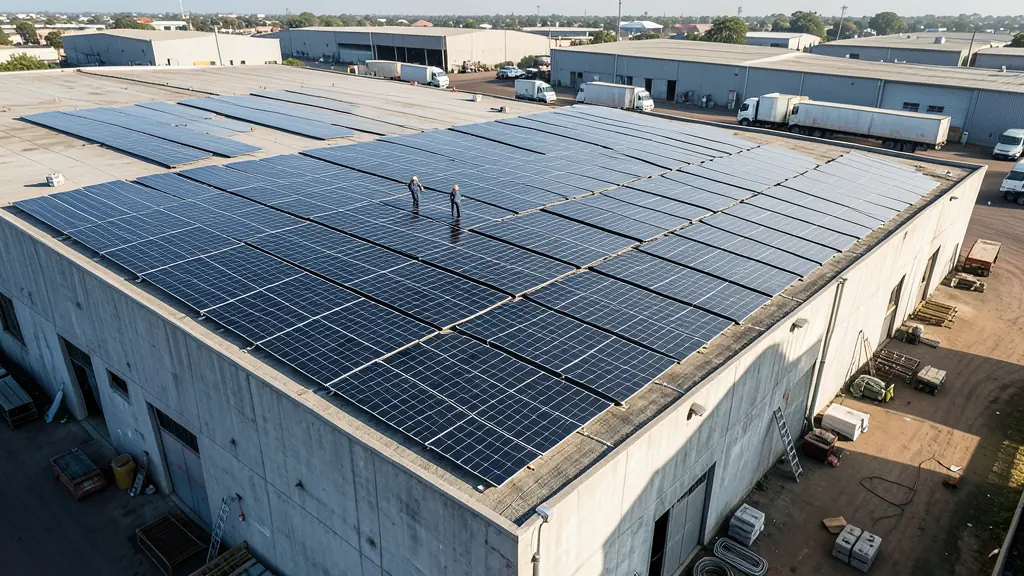
Commercial solar installation puts photovoltaic panels on the roof, carport or ground of a business so that some of its daytime electricity comes from the sun instead of the municipal or Eskom grid. Shops, offices, schools, clinics, factories, cold stores and malls all use it. SolarPanel.co.za is a free quote service: one form sends your request to independent commercial installers in your area, who each quote you directly. We do not design, supply or install systems ourselves, and there is no fee and no obligation to accept a quote.
How commercial solar systems work
A commercial system is sized around the business's daytime load, not around the roof. The panels feed one or more three-phase inverters, and the power is used on site before anything is drawn from the grid.
- Grid-tied: the simplest and most common. It cuts grid use during the day but switches off in an outage unless it is paired with a battery or generator controller. See grid-tied solar systems.
- Hybrid: adds batteries to keep tills, servers, refrigeration or security running during load-shedding.
- Zero-export: a controller limits output so nothing flows back into the network, which is often what a municipality asks for first.
Capacity is quoted in kWp for the panels and kVA for the inverters.
Roofs, carports and ground mounts
An installer starts with the roof. Flat concrete and IBR or corrugated sheeting are the most common on commercial buildings, and each takes a different mounting system. Older asbestos-cement roofs need special handling and are usually not worked on directly, so a separate structure may be recommended.
Where the roof is shaded, weak or too small, carports over parking bays give shade for vehicles as well as power. Open ground behind a factory or school can take a ground-mounted array. In coastal areas such as Durban and Cape Town, ask for corrosion-resistant fixings. In hail country on the Highveld, ask about module hail ratings and wind loading. A structural engineer's letter is often needed for large arrays.
Approvals, wiring and compliance
A commercial installation falls under SANS 10142-1 and SANS 10142-1-2 for PV installations, and the installer must issue an Electrical Certificate of Compliance through a registered person. Grid-tied inverters should be on the NRS 097-2-1 approved list.
Your municipality or Eskom must approve a small-scale embedded generation (SSEG) application before the system is connected, and larger sites may need a separate generation licence check. Some municipalities offer feed-in credits, others do not. Tell your insurer, and ask your accountant whether tax allowances such as Section 12B apply to your business. A good installer handles the paperwork or explains clearly what you must submit.
What affects the price of a commercial solar system
There is no honest standard price per kWp, because every site differs. We do not quote prices, but these are the things that move a quote:
- System size and how much of it you actually use during the day.
- Roof type, condition and height, and whether strengthening is needed.
- Batteries, if backup is part of the brief.
- Length of cable runs, switchgear upgrades and distribution board work.
- Monitoring, metering and any export limiting.
- Approval fees and engineering letters.
- Whether you buy outright or use a finance or rental arrangement, covered under solar financing.
Send your latest electricity bill details with your request so installers can size the system properly.
What to include in your request
- State your average monthly kWh and when you trade
- Say whether the supply is single or three phase
- Describe the roof type, age and approximate area
- List what must keep running during outages
- Mention if you rent the building and need landlord consent
Commercial Solar at different properties
- Family homes: small home-office or shop-front systems on a family house that doubles as a workplace
- Estate homes: clubhouse, gatehouse and common-area systems that offset the estate's daytime lighting and pump loads
- Townhouses and flats: body corporate systems that power lifts, lighting and water pumps in the common areas
- Farms, smallholdings and lodges: packhouses, dairies and workshops running on daytime solar, often with a generator as backup
- Shops, offices and schools: shops, offices, schools and clinics using rooftop panels to cut daytime grid use and cover outages
- Factories and warehouses: large factory and warehouse roofs, carports and grid-tied arrays sized to heavy daytime machinery loads
Frequently asked questions
Does SolarPanel.co.za install commercial solar systems?
How big a commercial solar system do I need?
Do I need approval before switching on a commercial solar system?
Can commercial solar keep my business running during load-shedding?
Commercial Solar by province and city
- Johannesburg
- Pretoria
- Centurion
- Midrand
- Sandton
- Randburg
- Roodepoort
- Krugersdorp
- Randfontein
- Germiston
- Boksburg
- Benoni
- Kempton Park
- Alberton
- Vanderbijlpark
- Vereeniging
- eMalahleni (Witbank)
- Middelburg
- Secunda
- Mbombela (Nelspruit)
- Rustenburg
- Brits
- Klerksdorp
- Potchefstroom
- Polokwane
- Tzaneen
- Lephalale
- Kimberley
- Kathu
- Upington
- Bloemfontein
- Welkom
- Sasolburg
- Durban
- Pinetown
- Pietermaritzburg
- Richards Bay
- Newcastle
- Ladysmith
- Gqeberha (Port Elizabeth)
- East London
- Kariega (Uitenhage)
- Cape Town
- Bellville
- Paarl
- Stellenbosch
- George
- Worcester
More solar products and services
Solar panels & mounting
Solar power systems
Inverters & batteries
Solar geysers & pool heating
Solar pumps & lights
Get free solar quotes
Tell us what you need and where. An installer or supplier who works in your area quotes you directly. Free, no obligation.
Size it roughly (optional)
Tick what must keep running when the power is off. The estimate goes into your request so installers can quote closer to what you need.
5.0 kWh per kWp a day
Tick a few loads or enter your monthly units to see a size.
A rough guide only. An installer confirms the size after looking at your bill, roof and distribution board.