
Base Silicon Core in Photovoltaic Cells
Silicon as the Primary Semiconductor Element
More than ninety percent of the global photovoltaic market relies on silicon, a fact that often surprises those who first investigate solar technology. This prevalence is not a random choice. Silicon is the base substrate for the vast majority of panels due to its semiconductor properties and relative abundance in the earth’s crust. When you ask what a solar panel is made up of which material, the answer begins with this element, processed into wafers.
Photovoltaic cells demand high-purity silicon, far beyond the grade used in construction. Manufacturers melt and recrystallize it to form a single, continuous crystal lattice. This structure allows electrons to move predictably when struck by sunlight. I find it remarkable that a material so common can be refined to nearly 99.999999% purity to perform this work. The functional layers of a cell, the anti-reflective coating and electrical contacts, all exist to support the interaction happening within the silicon.
The journey from raw sand to a functioning cell requires several steps:
– Metallurgical-grade silicon is extracted from quartzite.
– It undergoes a chemical conversion to create a gaseous compound.
– A deposition process transforms that gas into a polycrystalline rod.
– The rod is sliced into thin wafers and polished clean.
These wafers then receive trace amounts of boron or phosphorus to create the electrical field necessary for power generation. This doping process is the final step in defining the core of the cell. Without this precise foundation, the entire panel would fail to produce a useful current. Understanding what a solar panel is made up of which material ultimately clarifies why silicon remains the industry standard, as its electrical stability and cost efficiency are unmatched for terrestrial use.
Differences Before Monocrystalline and Polycrystalline Silicon
The choice between monocrystalline and polycrystalline cells often comes down to manufacturing shortcuts, not just aesthetics. Both types start from the same base material, but the way that silicon cools and crystallizes defines their performance. Monocrystalline panels are sliced from a single, continuous crystal ingot. Polycrystalline panels, by contrast, are formed by melting multiple silicon fragments together in a mold. This simpler process creates internal boundaries where the crystal grains meet. Those boundaries disrupt electron flow, which is why polycrystalline cells are generally less efficient in real world conditions.
The manufacturing process also dictates the physical shape of the cells. Monocrystalline cells have a distinctive, uniform look with cut corners, while polycrystalline cells have a speckled, blue appearance. That speckle is the visual fingerprint of the internal grain boundaries. For a rooftop in South Africa, where space can be limited and summer heat is intense, the efficiency gap matters more than you might think. Monocrystalline cells handle high temperatures better, meaning they lose less output when the sun is at its peak. Polycrystalline cells cost less to produce, but they require more roof area to deliver the same wattage.
When you are evaluating what a solar panel is made up of which material, the purity and crystalline structure of that silicon core is the deciding factor. While both options use the same semiconductor foundations, there is a clear distinction for the buyer:
– Monocrystalline panels offer the highest efficiency, perfect for limited roof spaces.
– Polycrystalline panels offer a lower upfront cost but require a larger installation footprint.
– Heat performance favors monocrystalline in South African summer conditions.
Your decision hinges on whether you have open area or you need to maximize every square meter of roof space. The silicon base is identical; the crystal alignment is what changes the outcome. That structure dictates how long your system takes to pay for itself.
Doping and Junction Formation: Phosphate and Boron
The raw silicon in a photovoltaic cell would remain inert if we left it alone. A lonely crystal conducts poorly. To awaken it, manufacturers introduce two carefully selected atoms, phosphorus and boron, through a process called doping.
Phosphorus carries extra electrons and creates the n-layer. Boron, with one fewer electron, forms the p-layer. Where they meet, the junction builds an internal electric field that nudges freed electrons toward the circuit. The question of what a solar panel is made up of which material, therefore, reaches beyond the silicon slice. It includes these atomic infusions that make power collection possible.
– Phosphorus adds mobile electrons to the lattice.
– Boron stabilises the opposite side of the field.
– The junction between them directs electricity.
This pairing turns a passive wafer into an active generator of direct current.
Refining Silicon to Solar Grade Purity
The raw material emerges from quartzite, a rock humbler than the finished wafer. Manufacturers crush this stone and blend it with carbon inside an electric arc furnace. The reaction yields metallurgical-grade silicon, a substance too imperfect for energy capture. Its purity hovers near 98%, leaving too many impurities for effective conversion.
Refining to solar grade purity demands transformation. The Siemens process converts silicon into trichlorosilane gas, then distils it repeatedly. The outcome is polysilicon of remarkable cleanliness:
- Solar-grade silicon reaches 99.9999% purity.
- Electronic-grade silicon reaches 99.9999999% purity.
- Metallurgical-grade silicon stalls at roughly 98%.
Why do we demand such exacting standards? Trace metals inside the crystal lattice create recombination centres. These defects capture excited electrons and dissipate their energy as heat, robbing the cell of current. The question of what solar panel is made up of which material hinges on this refining rigour. The final polysilicon is remelted into ingots and sliced into wafers.
Alternative Jacket and Thin-Film Materials
Cadmium Telluride as a Commercial Thin-Film Material
CdTe panels account for roughly 90 percent of the world’s thin-film solar market. That share makes cadmium telluride the definitive commercial answer to what a solar panel is made up of which material, particularly for utility-scale projects.
A production line deposits the semiconductor onto glass with high speed. I find that efficiency impressive! The cell structure relies on:
- A glass superstrate that doubles as the front jacket
- A transparent conductive oxide to collect electrons
- A thin cadmium telluride absorber layer
- A metal back contact and protective laminate
This glass jacket approach slashes material usage compared to crystalline wafers, though cadmium’s toxicity and tellurium’s rarity remain trade-offs.
Copper Indium Gallium Selenide and Energy Conversion
Copper indium gallium selenide, or CIGS, offers a different answer to the question of what a solar panel is made up of which material. Unlike cadmium telluride, CIGS does not rely on a glass superstrate. The semiconductor layers sit on a flexible substrate, which opens possibilities for curved surfaces and lightweight installations.
The energy conversion in CIGS cells depends on precise tuning. Gallium adjusts the bandgap, indium provides conductivity, and copper facilitates charge collection. I find this process remarkable! The result is a thin film that rivals crystalline silicon in efficiency while using far less material.
- Flexible substrates reduce mounting constraints
- Bandgap tuning optimises light absorption
- Lower material usage cuts production costs
For South African conditions, where sunlight is abundant, CIGS panels present a compelling option. The question of what a solar panel is made up of which material becomes less about tradition and more about application.
Consumer-Dye and This- and Other Emerging Examples
The question of what a solar panel is made up of which material grows more complex with each passing year. Beyond the established players, a fringe of alternative jackets and thin-film materials stirs into view. Consumer-dye solar cells, for instance, capture light through photosensitised molecules. These organic compounds mimic the natural process of photosynthesis, yet they degrade faster than their inorganic cousins. For South African rooftops, where ultraviolet radiation is fierce, longevity remains a concern.
Perovskites have stolen the spotlight in laboratory settings. This crystal structure delivers remarkable voltage, but its lead content and moisture sensitivity present nettlesome hurdles. Meanwhile, organic photovoltaic polymers promise flexibility on a scale that glass cannot match. They bend, they fold, they cling to unusual surfaces. Their efficiency trails silicon, though the gap narrows yearly. The dance of innovation continues, and the true answer to what a solar panel is made up of which material may soon lean on these experimental heroics. For now, practicality wins the day, but the horizon shimmers with possibility.
Conductive Metals and Electric Circuitry
Silver Pastes and Their Use in Busbar Grids
When exploring solar panel is made up of which material, the focus often falls on silicon. Yet the conductive metals deserve equal attention. Silver paste, in particular, forms the electric circuitry that transfers captured sunlight into usable power. This paste is applied directly onto the silicon wafer, creating the thin, metallic lines known as busbar grids. These grids act as the panel’s nervous system, collecting electrons and routing them toward the external circuit.
The paste’s formulation is a blend of silver particles, glass frit, and organic solvents. The glass helps it bond to the silicon, while the silver provides high electrical conductivity. Without this precise combination, the cell’s efficiency drops significantly.
Consider why silver is chosen over other metals:
- It offers the highest electrical and thermal conductivity.
- It resists oxidation, ensuring long-term performance.
- Its paste can be screen-printed at high speeds.
Thus, while silicon converts light, silver paste ensures the resulting current actually flows. So next time you ask solar panel is made up of which material, remember the vital silver grid.
Aluminum as the Quickening for Durability
Aluminum completes the story of how a solar panel is made up of which material. While silver handles the electrical flow, aluminum takes on the physical strain. The frame, usually extruded from anodized aluminum, holds the glass, cells, and backsheet together. This frame resists corrosion and sheds water effectively.
- It supports the panel against wind and hail loads
- It anchors mounting clamps securely
- It allows for thermal expansion without cracking the glass
Aluminum also helps manage heat. The metal conducts warmth away from the cells, which matters because efficiency drops when panels run hot. A well-designed frame reduces thermal stress and prevents micro-cracks over time. In my years working with solar systems, panels with weak frames tend to fail long before the cells do.
Copper Ribbons and Interconnect Cells
The electrical pathway relies on copper ribbons. These tinned strips solder directly to the silver busbars on each cell. The ribbons gather the flowing electrons and carry them downwards. Without this copper, the photovoltaic effect stays trapped at the cell surface.
Interconnect cells depend on these flat wires. A solar panel is made up of which material that ensures minimal resistance? Copper is the choice for its conductivity and cost. The ribbons weld adjacent cells into a series. This series builds voltage. The entire array then terminates at a junction box. This is where the direct current exits. I have seen cheap panels use thinner copper; they suffer hot spots. Proper gauge is non-negotiable.
Protective and Encapsulation Layers
Tempered Glass Attending Impact Resistance and Light Pass
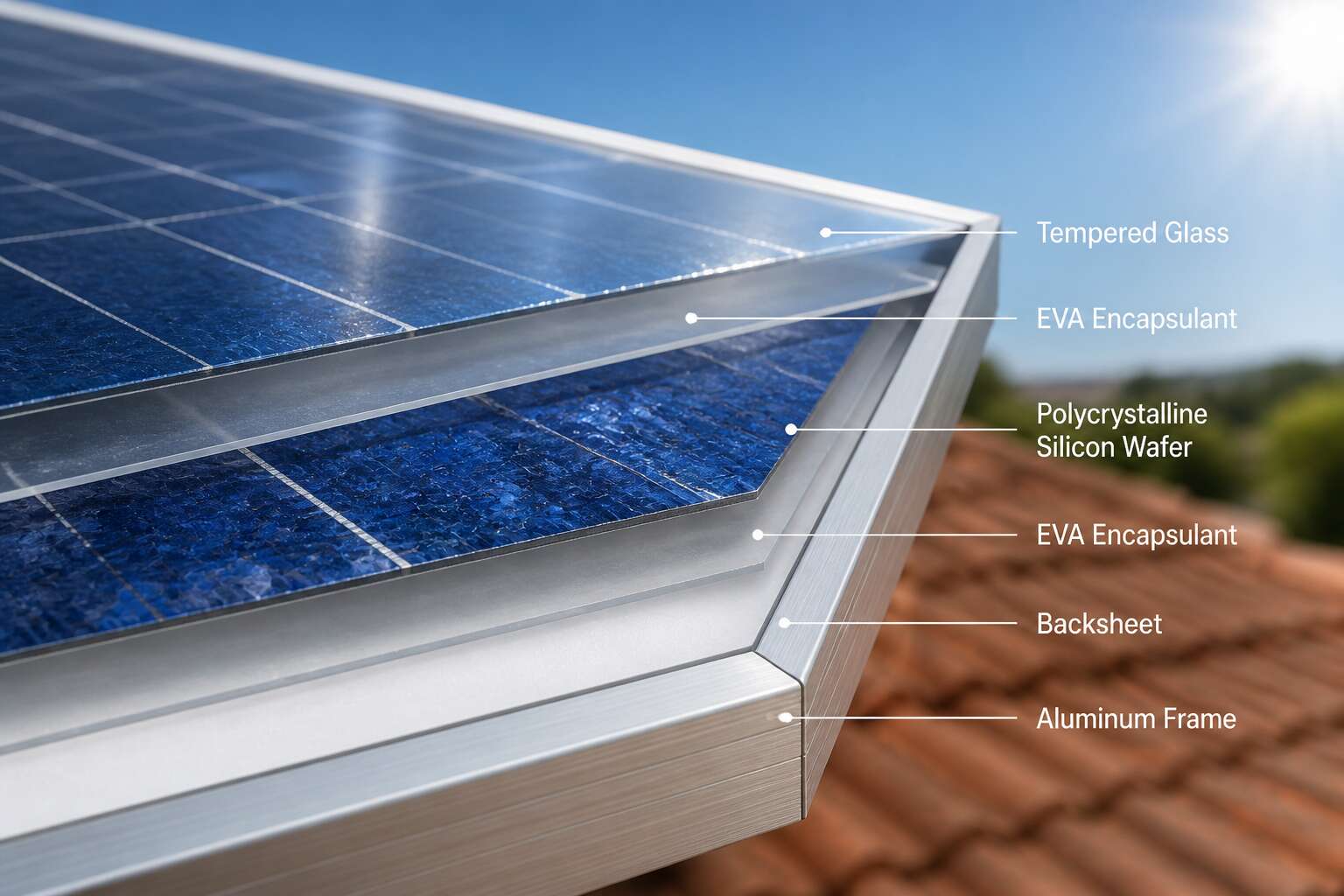
Tempered glass, the outermost layer of a solar panel, resists hail and abrasive debris effectively. Thermal pre-stressing makes this glass several times stronger than standard panes. In highveld storms, this layer separates a functioning array from broken cells.
Beneath the glass lies an encapsulation layer, often ethylene vinyl acetate. This polymer bonds silicon cells to the front glass and rear sheet, letting sunlight through while blocking moisture and oxygen. Without it, corrosion would destroy wiring within weeks.
- Shock absorption through mechanical resilience
- UV filtering to prevent polymer degradation
- High light transmission via optical clarity
People often ask solar panel is made up of which material. The usual answer is silicon, but that remains incomplete. The protective stack of glass and encapsulant is equally vital. These materials define durability and efficiency, proving that the answer requires more than a single element.
Ethylene Vinyl Acetate Encapsant Applied for Bonding
Between the tempered glass and the silicon wafer sits ethylene vinyl acetate, or EVA, a thermoplastic polymer tasked with adhesion. During lamination, the sheet melts near 150 degrees Celsius and cross links, forming a permanent bond across the entire module stack.
This layer reframes the question of solar panel is made up of which material. The mechanical answer includes EVA, and this polymer determines whether the cell survives decades of South African UV exposure and thermal cycling. EVA must transmit over 90 percent of incoming light, block moisture, and resist yellowing as it ages.
- Bonding strength that endures wind loading and hail impact
- Optical clarity for maximum photon absorption
- Chemical stability against acetic acid formation
Poor EVA selection causes delamination and efficiency collapse, a known failure mode in budget panels after a few Highveld summers.
Polymer Backsheet Defended Against Moisture and Ultraviolet
The polymer backsheet rarely gets credit. Ask the question solar panel is made up of which material and most people recite silicon, glass, perhaps busbars. The rear skin carries the serious duties. It stops moisture from reaching the cell and blocks ultraviolet light that would otherwise embrittle the EVA layer above.
A proper backsheet uses a laminate, typically PET reinforced with PVF or polyamide. It holds electrical insulation, resists hydrolysis, and survives Highveld sun. I have seen budget modules develop brown streaks after three years. That is the backsheet failing.
- Moisture vapour transmission below 2 g/m² per day
- UV degradation resistance after 25 years of direct exposure
- Adhesion to EVA without delamination or bubbles
Cheap backsheets yellow and crack. Acetic acid forms, and the module corrodes from the inside out. So when someone asks solar panel is made up of which material, remember that the backsheet is part of the answer.
Aluminum Frame Structures for Center Heat and Stability
When asking what a solar panel is made up of which material, the aluminum frame deserves more attention than it gets. This structural border does far more than look tidy. It locks the entire laminate together, wicks away heat from the cells, and keeps the glass from flexing under hail or wind load. Without that stiff perimeter, thermal expansion would slowly crack the delicate silicon inside.
Beneath the frame, encapsulation layers act as a protective cushion. Ethylene vinyl acetate (EVA) surrounds the cells on both sides, absorbing shock and preventing moisture from creeping toward the electrical contacts. These layers also help distribute heat evenly across the module, which matters because hot spots reduce output and accelerate degradation. A well-designed encapsulation system keeps the internal temperature stable even under the harsh South African sun.
- Aluminum frames resist corrosion and are fully recyclable
- Encapsulation prevents air bubbles that cause delamination
- Proper edge sealing blocks humidity from reaching the busbars
So when you picture a solar panel, remember that the frame and the inner glue layers are what hold everything together under real weather. They are the quiet guardians of every watt produced.
Connector Boxes and Rubber Junction Insulation
Most people stop at the glass and frame, but the connector box is where the panel actually speaks. When you examine what a solar panel is made up of which material, look past the silicon. This sealed compartment attaches to the backsheet and houses the electrical connections that route current outward. Rubber junction insulation cushions the terminals and blocks moisture from creeping toward the busbars, which would otherwise corrode in a few rainy seasons.
The enclosure also contains bypass diodes, tiny one-way gates that protect the module when shade covers part of the surface. Without them, a single leaf could drag down the whole string’s output. Rubber insulation seals the cable entry points against humidity, and a proper IP67-rated box lets heat escape through the gland.
- Bypass diodes limit heat buildup in shaded cells
- Gland nuts keep the cable grip secure
- Factory-torqued connectors prevent arcing
Sourcing, Lifetime and Recycled Footpieces
Rarity – Seed Materials and Your Availability
When you ask what a solar panel is made up of which material, the answer begins with silicon. Crystalline silicon forms the photovoltaic cells, the heart of the module. But a single panel is a sandwich of many layers. The front uses tempered glass for protection. The backsheet prevents moisture ingress. A metal frame, usually aluminum, provides structural integrity.
Consider the typical construction:
– Silver paste creates the electrical busbars.
– Copper ribbons connect the cells.
– Ethylene vinyl acetate (EVA) acts as the encapsulant.
– Aluminum frame holds everything together.
Beyond the cell, the question of solar panel is made up of which material extends to the junction box and connectors. Each material serves a distinct purpose, from conductivity to durability. Understanding this composition is essential for evaluating efficiency and longevity. The primary semiconductor remains silicon, whether monocrystalline or polycrystalline, but the supporting materials are equally vital for real-world performance.
The Lifecycle of a Manufacturing Liberation
A solar panel’s true value emerges only across its full lifetime, a span often exceeding twenty-five years. Sourcing begins with high-grade quartzite, mined with considerable energy input to reach the metallurgical grade. The refinement into solar-grade polysilicon is an energy-intensive process, one that defines the panel’s initial environmental footprint. The question of solar panel is made up of which material becomes a question of responsible supply chains, particularly for the silver and copper that are so critical to conductivity.
The operational phase is quiet, with the panel generating electricity without moving parts. Yet degradation is inevitable, driven by ultraviolet exposure and thermal cycling. The EVA encapsulant can discolor, and the backsheet can become brittle. Most manufacturers guarantee performance for decades, but the physical reality of aging is absolute non-negotiable. The materials must simply endure.
When a panel finally reaches its end-of-life, the material story turns again. Over 80% of the mass is recoverable. This is the liberation stage.
1. The aluminum frame is removed without significant effort.
2. The glass is separated and crushed for new glass production.
3. The silicon wafers are processed through thermal and chemical treatment.
4. The silver and copper are reclaimed through electrowinning.
Recycling transforms what could be waste into a secondary source of materials. For South Africa, where landfill space is at a premium and natural resources are finite, this circularity matters. The recovered silicon can be remelted into new ingots, and the silver can re-enter the electronics market. The initial energy investment is partially reclaimed. So, when you ask what a solar panel is made up of which material, remember that the answer now includes a second life. The industrial ecosystem is one of extraction, endurance, and eventual rebirth, a full cycle that lowers the cost of future energy systems.
How Material Selection Impacts End-of-Use Recyclability
Most solar panels begin life as a mountain quarrel. Extracting the quartzite is the easy part. The real cost appears during purification, where enormous furnaces burn through energy to transform sand into metallurgical silicon. This entire manufacturing phase is a trade-off. Build a panel with fewer materials, and you save on upfront cost but might sacrifice durability. Choose a sturdier design, and you lock in a higher energy payback period. The question of what a solar panel is made up of which material directly influences how much carbon was emitted before the panel ever sees sunlight.
The material menu also dictates the dismantling process decades later. A panel with a polymer backsheet and EVA encapsulant is a sticky puzzle. You cannot simply peel it apart. Recyclers must shred the laminate and use thermal separation to free the silicon cells. The recoverable value is split unevenly:
- The aluminum frame is pure profit, easy to strip and remelt.
- The glass is heavy but low-grade, crushed into aggregate.
- The silver busbars are the hidden treasure, extracted via electrolysis.
- The silicon wafers are the most fragile and the hardest to reclaim cleanly.
A panel designed with fewer layers or easier separation points would slash recycling energy. But the industry prioritizes longevity. The solar panel is made up of which material choices that guarantee 25 years of output create a tough shell that resists dismantling. For South African recycling operations, where electricity costs are high, that thermal separation step might eat the profit margin. The greener panel is the one that anticipates the wrecking ball, not just the sun.



0 Comments