
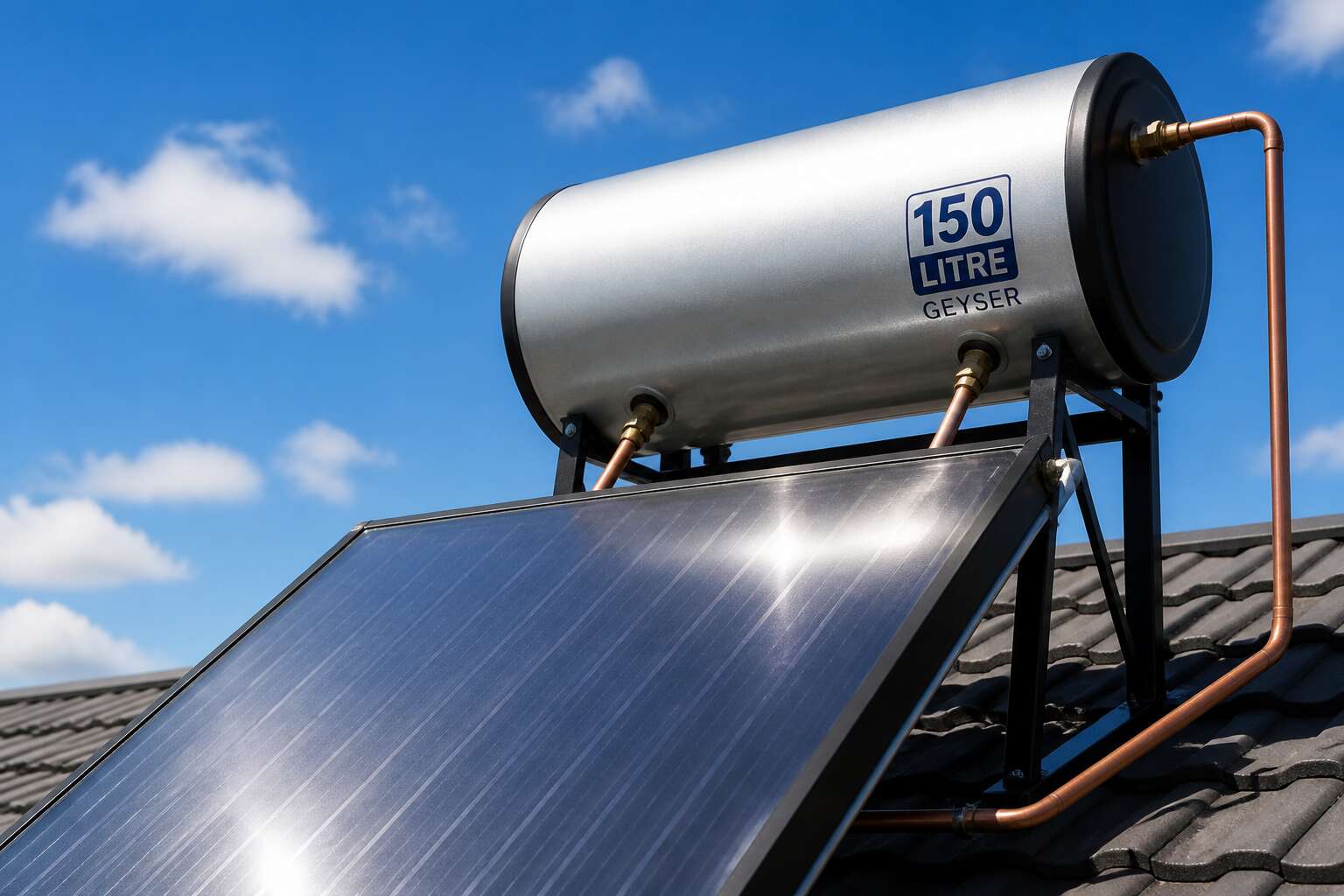
Assessing Your 150L Geyser Energy Needs
Calculating Daily Hot Water Consumption
Your 150 litre geyser consumes up to 40% of your monthly electricity bill. That is a financial leak worth plugging. Before you invest in a solar panel for 150l geyser, you need an accurate figure for daily hot water usage, not a hopeful estimate.
Start by counting the realities of your household. Every shower, bath, and basin of warm water adds up. A conservative benchmark sits at 50 litres per person per day, but that figure wobbles depending on shower flow rates and whether you hand wash dishes or rely on a dishwasher. Consider these variables:
- Number of permanent residents
- Shower duration and flow rate
- Frequency of laundry cycles using warm water
Each variable shifts your total, sometimes by more than you expect. An accurate consumption figure ensures you choose the right solar panel for 150l geyser capacity, avoiding both undersized systems and overpriced excess.
Understanding Geyser Element Wattage
I’ve seen homeowners obsess over tank size while ignoring the element that actually does the work. Your 150 litre geyser likely runs a 3kW element, but some units carry 2kW or 4kW. That wattage determines how aggressively your geyser pulls power, and it directly shapes what a solar panel for 150l geyser needs to replace.
Assessing your energy needs starts with reading the element label. Wattage tells you the speed of heating, not the total energy. A 3kW element running for two hours consumes 6kWh, while a 2kW element needs three hours for the same result. Your recovery time matters more than the tank’s volume!
- Identify your element’s wattage from the manufacturer plate
- Track daily run hours using a simple meter
- Multiply both numbers to understand your true load
That number becomes the foundation for sizing your solar investment, and it forces an honest conversation about your household’s daily patterns.
Seasonal Sunlight Variations
South Africa’s solar resource shifts dramatically between seasons. Johannesburg enjoys roughly 6.5 peak sun hours in December, but June drops to 4.5. Cape Town faces an even wider gap, with winter storms cutting entire days of sunlight! That seasonal swing directly shapes what a solar panel for 150l geyser must deliver.
Your geyser demands the same energy regardless of the sky, yet winter mornings arrive cold while the sun climbs late. Cloud cover stretches recovery time, and colder incoming water requires extra heat. This forces honest assessment of your winter generation.
- Winter peak sun hours can fall 30% below summer averages
- Western Cape overcast spells reduce output for consecutive days
- Regional weather patterns matter more than national sunshine statistics
Durban’s summer thunderstorms differ sharply from the Karoo’s endless clarity. Your location, not generic data, determines the true capacity for a solar panel for 150l geyser.
Choosing the Right Solar Components
Panel Wattage and Efficiency Considerations
South Africa basks in over 2,500 hours of annual sunshine, yet most geysers still rely on Eskom’s erratic supply. Choosing the right solar panel for 150l geyser requires matching wattage to your actual heat demand, not to the maximum sticker number. Efficiency matters more than raw size, since a premium 18% efficient panel extracts more usable energy from the same square meter of roof than a bulky 15% unit.
Consider these three factors when comparing panels:
- Temperature coefficient, which tells you how much output drops when the thermometer climbs past 40°C.
- Voltage compatibility with your charge controller, often overlooked until smoke appears.
- Physical footprint, because your roof has limited usable area.
Oversizing the array raises water temperature beyond safety limits. Undersizing produces lukewarm showers. The correct wattage matches your geyser’s element demand with the panel’s real-world production curve, not the idealised figures printed in glossy brochures.
Inverter and Charge Controller Selection
The solar panel for 150l geyser delivers raw energy, but the charge controller and inverter decide whether that energy reaches your element intact. South Africans face a peculiar challenge: our grid surges and drops without warning, punishing components that lack tolerance.
An MPPT controller beats PWM for this application because it extracts usable current from the panel even when clouds roll over Johannesburg. Match the controller’s input voltage to your panel array’s cold-start output, not the warm-day figure. For the solar panel for 150l geyser systems, this oversight causes most early failures!
- Verify the inverter delivers pure sine wave output; geyser elements hum on modified sine, but the thermostat suffers.
- Check surge ratings, since a 150l element draws more on startup than its nameplate suggests.
Placement of the charge controller near the geyser minimises cable losses, while the inverter’s transfer time hinges on your load-shedding schedule.
Battery Sizing for Continuous Operation
Nobody buys a battery bank for fun. They buy it because Eskom’s schedule shifts without warning, and a cold shower at 9pm is a poor reward! For a solar panel for 150l geyser, the battery determines whether you bathe warm or not.
I have watched homeowners size their bank for one sunny day, then regret it through a week of clouds. Capacity must cover the geyser’s daily draw plus a margin. Lead-acid batteries prefer a 50% depth of discharge; lithium handles 80% but costs more. Calculate your autonomy days, the number of overcast days your solar panel for 150l geyser must survive.
Peukert’s law punishes lead-acid assumptions: a 100Ah battery delivers less under heavy load. Read the discharge curve, not the label. Temperature matters too. A battery in a Johannesburg garage in July performs differently than one in Durban.
Roof Space and Mounting Orientation
In South Africa, usable north facing roof is often scarcer than sunshine. A 150l geyser needs 2.5 square metres of it, yet most Johannesburg homes offer less after chimneys, vents and satellite dishes claim their share. Choose the solar panel for 150l geyser with a tape measure, not a wattage calculator.
Orientation matters more than panel quality. A north facing tilt of 25 to 35 degrees captures winter sun when the geyser works hardest. East or west facing roofs lose up to 20 percent of usable irradiance, which translates into longer heating cycles.
- Usable roof area excludes shadows from trees and parapet walls.
- Roof angle should match your latitude; Pretoria sits at 25.7 degrees south.
Monocrystalline panels earn their premium here because they squeeze more power from limited square metres. The solar panel for 150l geyser becomes a puzzle of angles, shadows and physical constraints.
Installation and Integration with Existing Geyser
Direct DC vs AC Coupled Systems
The real magic happens when you wire your solar panel for 150l geyser into your home’s existing plumbing and electrical network. Direct DC systems connect the panel straight to a low voltage element, bypassing the inverter entirely. This approach achieves round trip efficiency above 90 percent, whereas AC coupled systems convert DC to AC and back again, losing roughly 15 percent of the energy to heat and conversion losses.
For most South African households, I recommend weighing these practical differences before you commit:
- Direct DC requires a dedicated element and controller, while AC coupled uses your standard geyser element and existing inverter.
- AC coupled systems allow you to sell excess power back to the grid, but direct DC keeps your hot water running during load shedding.
Installation complexity differs as well. Direct DC needs a separate DC wire run, whereas AC coupled integrates with your current DB board. Both can work with a 150 litre tank, but the right choice depends on your inverter’s capacity and how often you rely on municipal power.
Safety Cutoffs and Thermostat Compatibility
The humble thermostat, that unglamorous switch behind the access panel, rarely receives the consideration it merits. When you install a solar panel for 150l geyser, your existing thermostat becomes part of a subtle interaction. Most South African geysers use a 60 degree cutoff. Your solar controller must respect that limit, or the element switches off prematurely.
Compatibility with safety cutoffs is non-negotiable. I have watched a solar panel for 150l geyser installation fail because the thermostat and controller disagreed. Older geysers may have thermal cutoffs that trip at lower temperatures.
- The thermostat’s maximum temperature rating matches your controller’s setpoint.
- The safety cutoff resets automatically, not manually.
Direct DC systems bypass the thermostat entirely. That means your safety cutoff becomes the only guard against overheating. A conversation worth having with your installer.
Professional Installation vs DIY
On paper, adding a solar panel for 150l geyser looks straightforward. Under the roof, it becomes high-current wiring, water-tight glands, and mounting brackets built for highveld thunderstorms. A professional will assess the existing geyser connections, element polarity, and compliance before cutting a cable. DIY installers often focus on the photovoltaic side and overlook the hydrostatic side, only to discover a weeping connection when pressurised.
The real question is not skill level but accountability. Each role carries specific responsibilities:
- Electrical work on a geyser requires a Certificate of Compliance in most municipalities.
- Insurance cover may be void if a solar panel for 150l geyser is installed without an authorised person.
A DIY installation might save a few thousand rand upfront, but rework the integration later and the cost climbs quickly. Professional fitters test the element current draw and confirm the system matches the existing geyser.
Commissioning and First Run
Once the solar panel for 150l geyser is mounted and connected, commissioning turns theory into temperature. Open a hot tap and let the water run until the flow is steady. This removes trapped air. A dry element will self destruct quickly, so do not skip this step.
Switch on the power and listen near the geyser. The element should hum evenly. A gurgling sound means air is still inside. A crackle means something is loose. After thirty minutes, check the tank surface. Warm is expected. Hot enough to hurt means the thermostat has failed.
- Inspect all pipe joints for moisture
- Confirm the element draws the correct amperage
- Verify the solar controller logs panel output
A successful first run is quiet. Your solar panel for 150l geyser now works without attention, which is the highest compliment for any appliance.
Costs, Savings, and Payback Period
Upfront Equipment Cost Breakdown
In South Africa, the upfront equipment cost for a solar panel for 150l geyser typically lands between R8,500 and R15,000. That figure covers the essential hardware, but the breakdown surprises most first-time buyers. A standard kit includes:
- Solar panel (330W to 450W): R2,500 to R4,500
- Charge controller: R800 to R1,500
- Inverter: R3,000 to R6,000
- Mounting rails, cabling, and isolators: R1,200 to R2,000
Labour for professional installation adds another R2,000 to R3,500. So the total investment hovers near R12,000 on average. Here is the compelling part: with Eskom tariffs climbing past R2.50 per kWh, a solar panel for 150l geyser offsets roughly 4.5 kWh daily. That trims about R340 off your monthly bill. The payback period settles between three and four years, after which the system runs on pure margin for the rest of its lifespan.
Government Rebates and Incentives
The SARS energy rebate offered homeowners a direct credit of up to R15,000 for qualifying solar installations between March 2023 and February 2024. That incentive changed the entire cost structure of a solar panel for 150l geyser, turning a R12,000 investment into a sub-R10,000 outlay after the refund lands.
Your monthly savings remain the same at roughly R340 off the Eskom bill. But the payback period contracts noticeably, settling below three years instead of stretching toward four. Every month of delayed installation costs you that saving twice, once in lost rebate value and once in avoided tariff hikes.
Eligibility for municipal incentives requires:
– A certificate of compliance from an accredited installer
– Panels rated above 275W with a valid warranty
– Geyser controller registration with your local municipality
Cape Town and Johannesburg still run limited rebate windows for solar water heating retrofits. These programs shift annually, so the only way to pin down current figures is to check your municipal website directly. The R15,000 SARS credit has lapsed, but the structural saving of roughly R4,000 per year remains entirely within reach.
Expected Monthly Electricity Savings
For a typical South African household, the complete solar panel for 150l geyser setup lands between R18,000 and R25,000, including the controller and professional installation. The monthly saving on your Eskom bill usually settles around R340, pushing annual savings toward R4,000. Your exact figure varies by household.
- Panels and mounting hardware: R6,000 to R9,000
- Controller and wiring: R3,000 to R5,000
- Installation labour and certificate of compliance: R4,000 to R7,000
The payback period for that solar panel for 150l geyser is the cost divided by the monthly saving. At R340 per month, a R20,000 installation repays itself in about 59 months. If you angle panels to catch the midday sun, you might trim that closer to 54 months. Municipal rebates in Cape Town or Johannesburg can shorten the wait further, but those windows stay unpredictable.
Environmental Impact and Carbon Footprint
Water heating consumes up to 40% of the average South African home’s electricity, yet the solar panel for 150l geyser turns that drain into a source of independence. Costs hover between R18,000 and R25,000, but the number settles comfortably against what you no longer pay Eskom.
Each month, the system shaves roughly R340 off your bill. Over five years, that is more than R20,000 returned, placing payback near the 59-month mark. After that, the geyser runs on captured sunshine!
The environmental return arrives without calculation. A typical installation avoids over 1.5 tonnes of carbon dioxide yearly.
- Coal emissions decrease by approximately 12% per home
- Daytime heating shifts completely off-grid
This solar panel for 150l geyser reduces strain on the grid and secures your hot water for decades.
Long-Term Maintenance Expenses
The solar panel for 150l geyser transforms a monthly variable expense into a fixed asset with a known trajectory. The initial outlay, often between R18,000 and R25,000, settles against a monthly return of roughly R340. Payback arrives near the 59 month mark, yet the deeper financial story is what follows: decades of hot water without Eskom’s escalating tariffs.
Long-term maintenance remains the quiet advantage. The solar panel for 150l geyser demands little beyond occasional panel washing, connection checks, and sacrificial anode replacement every few years. These costs average below R800 annually, a small sum against the R4,080 saved each year. Inverter replacement at year ten stands as the largest recurring expense, but that single event lands after the system has already paid for itself.
- Panel cleaning twice per year
- Anode replacement every three years
- Inverter servicing at the decade mark
As electricity prices climb, the payback period shortens while maintenance costs remain stable. The system’s financial predictability becomes its quiet luxury, turning sunlight into a ledger line you stop fearing. That consistency, not the headline figures, defines the real value.
Payback Period Calculation for 150L Geysers
I run the numbers on a solar panel for 150l geyser starting with the installed price, which typically sits between R18,000 and R25,000. That figure covers the panel, frame, controller, and basic wiring. It seems significant until you place it against the R340 you no longer pay Eskom every month.
For a quicker estimate, take your own monthly geyser usage. Multiply it by your tariff to find your personal saving. Many households see R4,080 per year, which makes the payback period calculation for 150l geysers straightforward:
- Total installed cost
- Divide by monthly electricity saving
- The result is the number of months to break even
A R20,000 installation divided by R340 comes to 59 months. That is the break-even point. After that, the solar panel for 150l geyser keeps working, and the money it returns stays in your pocket for years!



0 Comments