
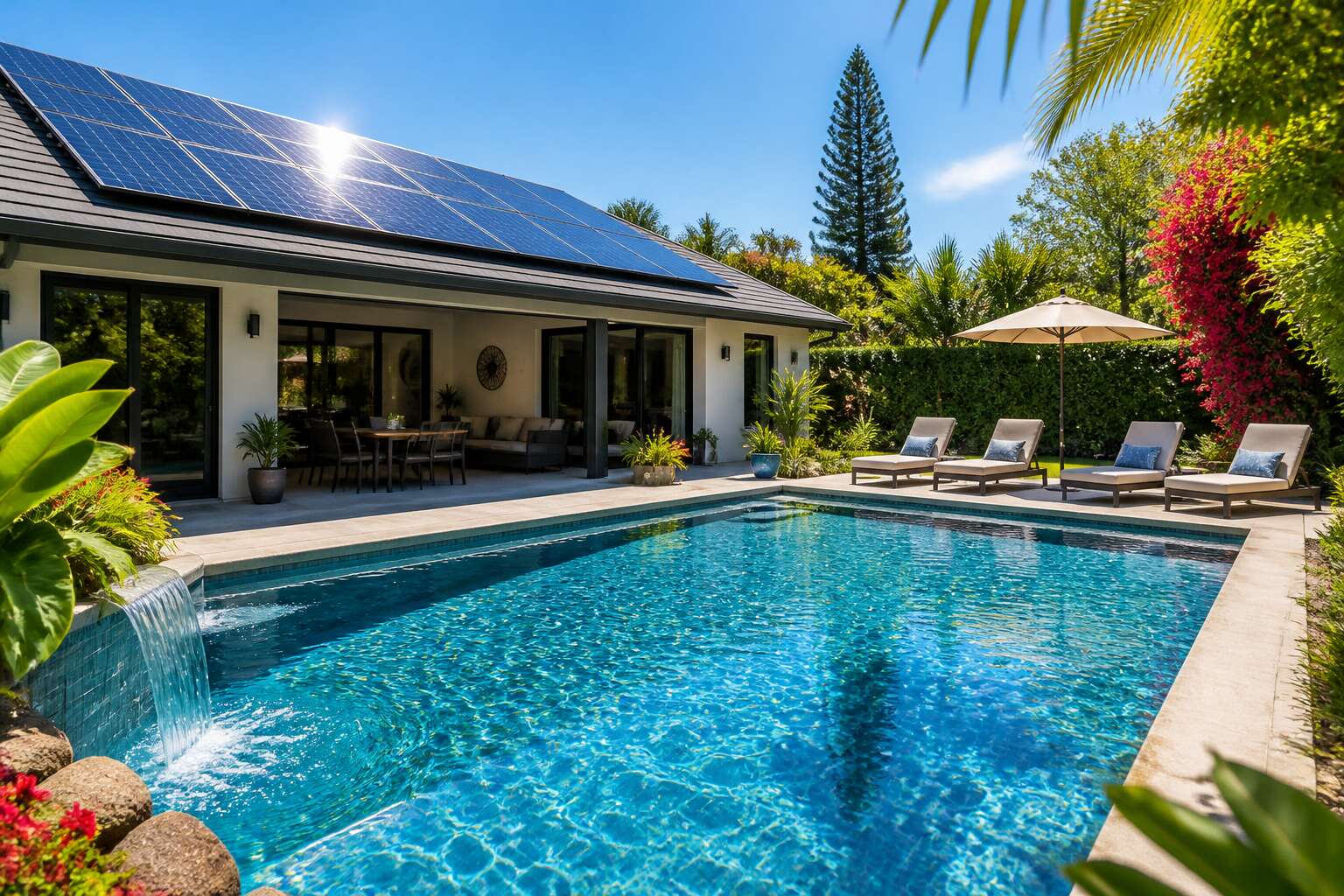
Why Switch to Solar-Powered Pool Heating
Slash Monthly Utility Costs Year-Round
South Africa’s relentless electricity tariff hikes make a solar panel pool system a pragmatic response. The Highveld receives over 3,000 hours of sunshine annually, yet most of that thermal energy escapes while your pool pump draws grid power to heat water. Capturing sunlight directly for heating fundamentally alters the cost structure.
Electric heat pumps routinely consume up to 40% of a household’s monthly energy budget. A solar installation reroutes that demand through collectors, avoiding Eskom’s escalating rates altogether. The system pays for itself through avoided utility costs, then continues producing hot water for years.
My own clients in Cape Town report enjoying winter swims without guilt. The setup operates independently of the grid, so scheduled load shedding never interrupts your heating cycle. That independence alone is worth the switch!
Shrink Your Carbon Footprint While Swimming
Every time a heat pump switches on in Gauteng, it draws coal-fired electricity from the grid into your water. The irony is palpable: you swim to escape, yet the pool itself carries the residue of a burning planet. A solar panel pool interrupts that transaction. Collectors on your roof convert sunlight into warmth without combustion and without emissions.
Here is what disappears from your household’s record of harm:
- Roughly 1.2 tons of CO2 avoided annually per average pool
- No reliance on Eskom’s coal-heavy grid for heating
- No refrigerant leaks from heat pump compressors
The water warms through direct radiation, the same force that has governed this earth since before humans named it. South Africa’s solar resource ranks among the most generous on the continent. A solar panel pool converts that abundance into a private, clean ritual. The pump still hums, but the conscience stays quiet.
Extend Your Swimming Season Without Noise
Gauteng winters bring sharp mornings, but the water need not stay cold. A solar panel pool extends your swimming season by months, not weeks. The collectors work silently on your roof, unlike heat pumps that hum and vibrate. You hear only the water moving through the pipes.
That silence matters. I have watched swimmers pause at the edge, listening. No compressor kicking in at dawn. No mechanical drone competing with birdsong. The warmth arrives on its own, and the sun does the work while you sleep.
- Swim from September through May without a single noise complaint
- No moving parts on the roof to wear out or rattle
- Water warms gradually, avoiding the shock of a cold plunge
An extended season changes how you use the pool. Evening swims become possible in autumn. Early laps no longer require a deep breath before entry. The solar panel pool sits, collecting heat, making no demands.
Core Components Every Solar Pool Heating System Needs
Collectors: Panels, Tubes, and Roll-Out Mats
The real work of any solar panel pool setup happens inside the collectors, the components that capture sunlight and transfer heat to water. Three main styles dominate the market: rigid panels, evacuated tubes, and flexible roll-out mats. Each offers a unique approach to the same task.
Rigid panels use small internal channels to maximise surface contact with the sun. Evacuated tubes act like thermos flasks, holding heat even on cooler days. Roll-out mats are the most forgiving, just unroll and connect.
- Panels: best for large pools with strong sun exposure.
- Tubes: ideal for year-round heating in variable climates.
- Mats: perfect for seasonal setups or temporary needs.
Your choice directly affects the long-term performance of your solar panel pool, so take time to match the collector to your site’s specific conditions.
The Circulation Pump and Filtration Role
South Africa averages over 2,500 hours of sunshine per year, but the sun alone does not heat a pool. That work happens inside the collector, though the circulation pump moves the warmth to your water. Without it, your solar panel pool simply sits there, full of stagnant heat. The filtration system plays a separate role. It removes debris before water enters the collector. This keeps the small channels clear and the system efficient. Here is what each component actually does:
- The circulation pump dictates the flow rate.
- The filter traps leaves and sand that would otherwise block the collector’s internals.
- A check valve prevents warm water from flowing backwards at night.
A pump with the correct horsepower for your roof height is critical! A filter that is too small creates resistance. Together, they ensure the entire loop operates without stress, season after season.
Diverter and Check Valves for Flow Control
On a Highveld winter night, a pool can shed 3 degrees Celsius. That is where the diverter valve earns its place, I assure you! It reads the temperature difference and decides whether water should flow up to your solar panel pool collectors or return directly to the pool. The check valve handles the reverse scenario. When the pump shuts off for the night, it blocks the heated water from sliding backwards through the pipes. Without that barrier, the collector vents warmth into the night sky.
Consider what happens when valves fail or are left out:
- Warm water drains backwards and cools the pool overnight.
- Air pockets form inside the collector, stopping the pump’s prime.
- Unbalanced pressure forces the pump to work harder, shortening its lifespan.
These components deliver the hydraulic balance that keeps your solar panel pool working as one loop. They ensure the sun’s collected warmth reaches the water.
Sensors and Automated Controllers
South Africa’s sun is generous, but a solar panel pool only thrives with precise oversight. I have seen systems where a single degree of miscalibration costs more warmth than a week of clear skies. Sensors act as the nervous system, measuring water temperature at the collector and the pool itself. The automated controller compares these readings and decides when to redirect flow, ensuring every kilowatt of solar gain is banked.
The logic is simple, yet the payoff is substantial. A reliable controller monitors:
- Collector temperature versus pool temperature
- Pressure drops across the filter
- Freeze risk on cold Highveld nights
This vigilance keeps your solar panel pool operating at peak efficiency without demanding your attention. The system adjusts itself, quietly, second by second, so you simply enjoy the warmth!
Piping Configurations and Heat Transfer Fluids
Piping is the circulatory system of a solar panel pool, yet it is the easiest component to neglect. A well designed layout pushes water through the shortest, straightest path possible. Friction is your enemy. Every 90 degree elbow steals a little warmth from the loop.
Choose the right pipe diameter. Too narrow strains the pump. Too wide drops flow velocity, which allows air pockets to form inside the roof collectors. Heat transfer fluid matters more than most owners realise. In South Africa, plain water works for coastal installations, but Highveld winters require a propylene glycol mix to carry heat without freezing overnight.
Consider three configuration choices:
- Swept bends instead of sharp elbows
- Insulated risers running to the collectors
- An air release valve at the highest point
The difference between a sluggish loop and a peak performance solar panel pool is often just a few centimetres of pipe and the right fluid in motion.
Selecting the Right Collector Type for Your Climate
Unglazed Rubber Mats for Warm and Sunny Regions
South Africa’s high solar irradiance makes unglazed rubber mats a sensible first choice for a solar panel pool. These black EPDM rubber channels absorb heat directly, with no glazing or insulation. In warm provinces like Limpopo, they transfer heat to the water with little daytime loss.
Unglazed options use their entire surface as an absorber. Heat moves efficiently into the circulating water without a glass barrier. The tradeoff appears at night, when mats shed heat faster than glazed panels. For installations in regions with mild evenings, that loss is acceptable.
- Check frost days; unglazed mats tolerate occasional cold snaps but not sustained freezing.
- Match mat area to pool surface, about 80 to 100 percent in sunny zones.
- Mount mats on a north facing roof for maximum midday heat gain.
Rubber mats handle chemical exposure and UV rays without cracking, keeping maintenance low for South African pool owners.
Glazed Panels for High Efficiency in Cooler Areas
Temperature differential decides which collector wins. In cooler South African regions like the Karoo or the Cape interior, the gap between warm water and cold air is wide. Unglazed surfaces shed heat quickly, but glazed panels hold their advantage. A transparent cover traps solar radiation, while an insulated backing slows thermal bleed through the night.
The absorber plate inside stays shielded from wind chill, which matters when afternoon southeasters strip warmth from exposed surfaces. Glazed panels maintain higher efficiency under diffuse light, where unglazed systems lose ground. I have seen homeowners in Gauteng and the Free State choose this configuration repeatedly.
Key traits of glazed panels:
- Tempered glass rated for hail common in highveld storms
- Aluminium frames that resist corrosion near coastal air
- Selective coatings that improve absorption without raising emissivity
This solar panel pool heating configuration delivers consistent output through autumn, when evening temperatures drop sharply. While the initial investment exceeds unglazed alternatives, the thermal retention changes the economics for year-round swimmers in colder provinces.
Titanium Heat Exchangers for Saltwater Pools
Saltwater pools present a problem: chloride ions that quietly corrode standard metal components. For a solar panel pool system, the collector choice must account for both your regional climate and the chemical load of the water. Titanium heat exchangers resist pitting and crevice corrosion, so they last longer between your pool and the sun.
In coastal South Africa, where sea salt hangs in the air, unglazed rubber mats may struggle. Glazed panels with selective coatings handle the humidity better, but the safeguard lies in the heat exchanger. Titanium’s oxide layer self-repairs, which is why marine engineers specify it for offshore duty.
- Match collector glazing to winter temperature ranges
- Verify the exchanger’s titanium grade for saltwater service
- Check flow rates to prevent scaling in hard water regions
Your solar panel pool investment pays off when every component tolerates its environment. Choose the collector for the climate, then protect the loop with titanium.
Roof-Mounted Racks vs. Ground-Level Frames
The climate dictates more than the collector’s glazing; it shapes the entire mounting strategy. For a solar panel pool in the Karoo, where sun is intense, roof-mounted racks offer simplicity and minimal ground disturbance. But along the Cape coast, wind loads demand a different calculation. Ground-level frames allow easier orientation adjustments and simpler maintenance access, though they consume yard space.
- Roof angle and structural integrity
- Prevailing wind direction and exposure
- Distance from the pool to the mounting site
- Shade patterns from trees or buildings
A solar panel pool system performs best when the collector faces north at the correct tilt. Roof mounts often fix you to the roof’s existing pitch, while ground frames let you optimise the angle for winter sun. The trade-off is aesthetic and spatial, but the thermal gain can be significant.
Sizing and System Design for Peak Thermal Output
Matching Collector Area to Your Pool’s Water Volume
The mathematics of warmth begins with your pool’s water volume. Every cubic metre of water demands a specific collector area to reach comfortable temperatures, and in South Africa’s high solar radiation zone, the ratio differs from European benchmarks. For most residential pools, the collector surface should measure between 60% and 80% of the pool’s surface area, though deeper pools require more.
Consider the orientation and pitch of your roof racks as well. North-facing collectors at a 30 degree angle capture the most intense midday sun, while east and west orientations reduce peak output by roughly 15%.
- Calculate total water volume in cubic metres
- Divide by 1.5 to estimate required collector square footage
- Adjust for shading and seasonal cloud cover
Oversizing a solar panel pool system creates unnecessary expense and potential overheating, while undersizing leaves your water tepid. A proper thermal audit balances collector area against your specific pool dimensions, ensuring every panel earns its place on your roof.
Optimal Tilt Angle and Orientation Toward the Sun
In South Africa, the sun’s noontime elevation swings by roughly 50 degrees between midsummer and midwinter. A solar panel pool array locked at one angle serves two opposing seasons. Set collectors at your latitude minus 10 degrees for summer dominance, or at your latitude for balanced year-round output. The Highveld’s thin air rewards a steeper pitch, while coastal humidity scatters less light.
Orient the array to true north, not magnetic north, and verify the correction for your province. Seasonal tilt adjustments can add 12% to winter output. A fixed rack demands compromise, but the sun’s path is predictable, and measurement beats guesswork.
- Confirm zero shading between 9am and 3pm.
- Match panel spacing to prevent self-shading at low winter angles.
- Recheck azimuth for your solar panel pool after roof modifications.
Avoiding Shade: Trees, Rooflines, and Neighboring Structures
A single overhanging branch can slash a collector’s thermal output by more than a third, yet most pool owners discover this only after their water refuses to warm. Sizing a solar panel pool demands more than square meter arithmetic. The sun’s path across the property, every tree, roofline, and neighbouring structure casting a shadow between 9am and 3pm, all of it matters.
South African winter shadows stretch long. A neighbour’s new double-storey addition can render a calculated array useless. Measure shade at solstice, not at equinox, because the December sun hides problems that June exposes.
- Hourly shadow maps during winter reveal the true usable area
- Shaded collectors must be subtracted from any output estimate
- A deciduous tree that sheds in May still blocks low winter sun
A smaller, unshaded solar panel pool system outperforms a larger, partially shaded one every time.
Parallel vs. Series Plumbing: Pros and Cons
Hydraulic design rarely gets the attention it deserves. When sizing a solar panel pool system, parallel plumbing lets each collector enjoy equal pressure, but it requires a pump with enough grunt to serve every branch. Series plumbing sends water through one continuous circuit, raising friction yet achieving hotter per-pass temperatures.
- Parallel: balanced flow and simpler troubleshooting.
- Series: compact piping, but uneven temperatures can plague the last panels.
For South African roofs, every solar panel pool owner should consider a hybrid layout. Match pipe diameter to total pressure drop, otherwise the final collector in a series run starves. That failure silently destroys peak thermal output and leaves you shivering in June.
Upgrading Pumps for Higher Flow Rates
Most solar panel pool installations fail because the pump was chosen last. The collector array demands a flow rate of 4 to 6 litres per minute per square metre. Without that volume, water lingers in the pipes and sheds heat to the roof.
Size the system by working backwards from the pump curve. Calculate total dynamic head, which combines pipe friction, elevation, and valve resistance. Then pick a pump delivering the required flow at that head. A cheap pump handles static lift but chokes on friction.
Upgrading to a larger pump reduces the temperature difference between inlet and outlet, keeping the collector at peak efficiency. It also flushes air pockets.
For your solar panel pool setup:
- Measure the distance from pump to collectors.
- Verify the filter pressure drop.
- Choose a pump holding flow at 5 L/min per square metre.
I once helped a client in Pretoria whose pool stayed cold despite perfect orientation. A new pump solved it.
Adding Controller Automation for Self-Regulating Operation
Peak thermal output starts with system design that treats every metre of pipe as part of a single hydraulic circuit. When collectors are fed through unequal pipe lengths, the closest panel steals flow from the furthest one. I balance manifolds and select pipe diameters so each collector receives the same volume. That is the difference between a solar panel pool that warms steadily and one that leaves cold spots.
Controller automation then maintains that balance in your solar panel pool. Instead of running the pump on a timer, a differential controller measures the temperature difference between the collector and the pool water. It circulates only when that difference is meaningful, and it modulates a valve to divert heat where needed. A good controller should monitor:
- Collector outlet temperature.
- Pool return temperature.
- Solar irradiance.
This loop keeps the system from overheating on high-sun days and prevents night-time heat loss.
Installation, Upkeep, and Long-Term Care
Hiring a Certified Installer vs. The DIY Route
South Africans love a braai and a bargain, but a solar panel pool install is no braai. Certified installers charge for their expertise because their mistakes are covered by insurance. Your DIY mistake is covered by your wallet.
What a certified installer provides:
- Roof anchoring that survives Cape Town winter winds
- Plumbing alignment without pinched O-rings
- Pressure testing before you fill the system
Upkeep follows the same logic. Long term, you will replace sensors and clean glazing. The question is whether you discover leaks through staining ceilings or through a warranty claim. Improvised installations tend to leak more. The solar panel pool system you purchased performs differently depending on who fitted it.
Routine Cleaning and Visual Inspection Checklist
Every solar panel pool system will decay if you abandon it. Installation decides the timeline. A fitting seated a half-turn loose will weep for years before you notice the stain on the ceiling. Pressure testing before filling prevents that slow failure.
Upkeep is a sequence of small observations. Sensors fail. Glazing clouds. The pump labours. Deterioration always arrives; the only question is whether you find it before it finds your ceiling.
Long-term care requires a simple inspection routine.
- Check pipe connections for weeping or white scale.
- Inspect glazing for cracks and calcium residue.
- Verify pressure readings against the manufacturer’s baseline.
- Clean the collector surface before summer peaks.
Do this twice a season, and your solar panel pool survives another year. Ignore it, and corrosion completes its work quietly, beneath your notice.
Winterization Steps to Prevent Freeze Damage
Freeze damage ends a solar panel pool system in one night. Installation decides your vulnerability. Panels must slope slightly to drain completely. Valves need to close properly. A half-degree error traps water, and the next cold snap splits a collector. Upkeep is equally unforgiving. Check the pressure gauge monthly. If the fluid level drops, air enters the system and creates pockets where ice can form. For long-term care, winterization becomes a ritual.
- Drain the collector array fully or add propylene glycol for freeze protection.
- Isolate the system with diverter valves to prevent pool water from circulating.
- Cover exposed pipes with insulation, especially where they enter the roof.
Once frozen, a cracked panel leaks silently for months. South African winters rarely cause this, but the highveld can drop below freezing. A solar panel pool that survives winter costs nothing; one that doesn’t costs everything.
Financial Insights: Costs, Savings, and Incentives
Upfront Pricing Breakdown: Equipment plus Labor
The average South African pool owner spends R12,000 per year on electricity to heat water, yet most never see that number shrink. Upfront pricing for a solar panel pool system breaks down into equipment and labor. Equipment costs range from R25,000 to R60,000 depending on collector type and area. Labor adds another R8,000 to R15,000 for professional installation. These figures vary by province and roof complexity.
Savings arrive through reduced grid usage. A properly sized solar panel pool can cover 70% of heating demand, cutting annual costs by R8,000. Payback lands between three and five years. Government incentives, while limited, include VAT rebates on renewable components. Some municipalities offer property rate reductions for green installations.
Consider this financial sequence:
- Get a load calculation from an installer.
- Compare three quotes to isolate labor margins.
- Apply for the solar tax credit before year end.
Each rand spent on this equipment returns steady dividends through lower monthly statements.
Comparing Operating Costs Against Gas and Heat Pump Heaters
In the eternal contest of pool heating, gas heaters are the flashy sprinters: they heat fast, but they guzzle. A gas heater burns through roughly R1,200 per month in peak season, and that figure climbs with tariff hikes. Heat pumps are more refined, costing around R600 monthly in electricity, yet their efficiency drops when the mercury does. A solar panel pool system sidesteps these recurring fuel bills entirely, using sunlight as its only currency.
Annual running costs tell the story:
- Gas heater: R7,000 to R9,000
- Heat pump: R4,000 to R6,000
- Solar panel pool: R500 to R1,000 for the circulation pump
Gas units last eight to ten years. Heat pumps average a decade. Solar collectors routinely exceed twenty years with minimal upkeep. As Eskom tariffs rise, the gap widens in favour of the sun.
Federal Solar Tax Credits and State Utility Rebates
South Africa lacks a direct stand-in for Federal Solar Tax Credits, though the Section 12B allowance grants businesses a one-year write-off on renewable infrastructure. Certain metros test municipal rebates, but the true financial leverage sits elsewhere.
Your solar panel pool returns capital through avoided grid purchases. The interest on a home improvement loan often trails the energy inflation curve. State Utility Rebates in foreign markets rarely cover complete arrays; South African buyers lean on tariff arbitrage instead. As Eskom hikes rates annually, the solar panel pool’s effective yield climbs. A R150,000 installation clears its hurdle in under eight years.
Estimating Your Payback Period and Lifetime Returns
With Eskom’s annual double digit hikes, a solar panel pool becomes a quasi bond with an inflation beating coupon. But how do you estimate the payback? Start with your current heating tariff and expected system output, then apply the annual Eskom escalation to those savings. In South Africa, the effective return on a R150,000 solar panel pool often exceeds 14% in year one, and that yield compounds as tariffs climb. Your lifetime returns depend on collector lifespan, pump energy use, and panel degradation rates. A well maintained system typically pays back in 7 to 8 years and then generates free heat for another decade. The key variables are:
- Your local solar irradiation and shading
- The pool’s surface area and temperature target
- The efficiency of your circulation pump
Each factor shifts the crossover point where cumulative savings overtake installation costs.


0 Comments