Performance Specifications of High-Wattage Modules
Nominal Power and Efficiency Ratings
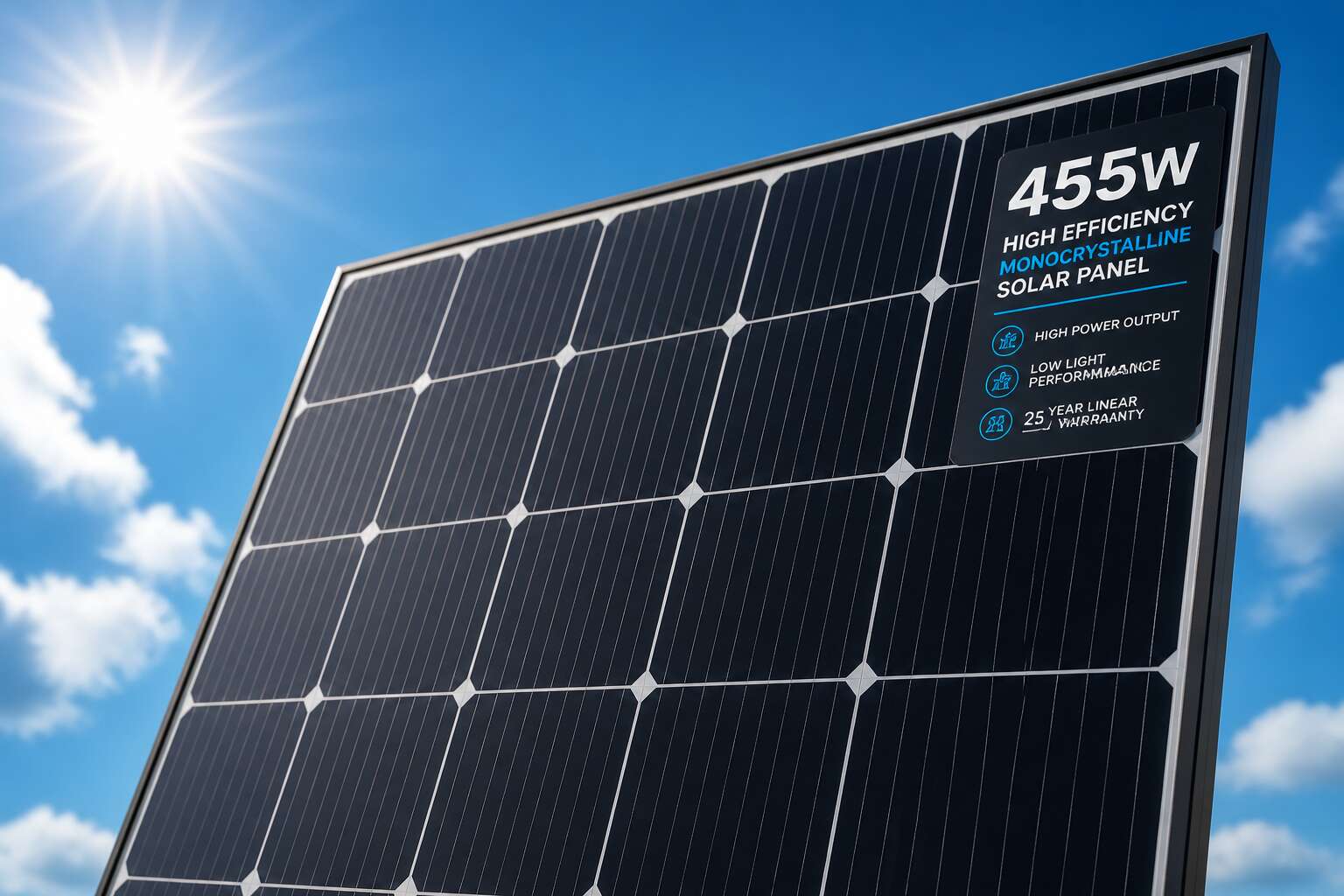
At 455W, a single module’s nominal power is more than a number. It reflects output under standard test conditions, a controlled snapshot of 1000 W/m² irradiance and 25°C cell temperature. Real world performance will differ, so efficiency ratings matter. For a solar panel 455w, efficiency typically lands between 20.8% and 21.5%. This ratio of sunlight to electricity affects roof space requirements. Higher efficiency means fewer units for the same yield.
The temperature coefficient deserves attention. Most high wattage modules lose about 0.34% per degree Celsius above 25°C. In South Africa’s heat, that loss becomes significant for the solar panel 455w. I have watched it erode returns in Gauteng! The specifications that matter include:
- Temperature coefficient, lower is better
- Degradation rate over 25 years
- Power tolerance and voltage ratings
A quality panel retains 84.9% of its output after 25 years. These specifications determine long term returns more than the upfront wattage.
Voltage and Current Parameters
Your inverter has a sweet spot, a voltage range where it extracts maximum power from the array. For a solar panel 455w, that margin depends on two unglamorous numbers: Vmp and Voc. The maximum power voltage (Vmp) typically sits near 42 volts, while short-circuit current (Isc) approaches 14 amps.
South African conditions complicate the picture. Cold Highveld mornings can push open-circuit voltage (Voc) up by 10%, risking overvoltage on your MPPT input. Conversely, scorching afternoons in the Lowveld drop Vmp below expected levels, leaving your inverter hunting for optimal voltage.
Key parameters to verify:
- MPPT voltage window range
- Maximum system voltage rating
- Temperature-compensated Voc limits
String sizing becomes the real test. The solar panel 455w’s voltage fluctuates with heat, so a fixed calculation fails. I always model both summer and winter extremes before committing to a design.
Temperature Coefficient and Thermal Behavior
The solar panel 455w is rated at a cell temperature of 25°C, a laboratory standard that real sunlight rarely honours. On a Lowveld summer afternoon, module temperatures climb past 60°C without much effort. For every degree above that baseline, the panel loses roughly 0.34% of its rated power. This temperature coefficient is an unglamorous specification, yet it determines whether the full rated capacity ever reaches your inverter on a working day.
Thermal behaviour rewrites the electrical profile as the day heats up:
- The maximum power point drifts lower.
- The voltage window tightens.
- Inverter tracking becomes a constant negotiation.
At 60°C, the module is delivering nearly 12% less than its label promises. No algorithm recovers that heat loss, and no wiring arrangement alters the physics of a hot rooftop.
Power Tolerance and Reliability
The rating printed on the back sheet is a best-case figure, measured in a lab and rarely matched on a real roof. Real installations judge a module by its power tolerance, the allowable deviation above or below the 455W label. A spec of 0 to +5W means the panel can exceed its nameplate without apologies. That margin cushions the inevitable drift of a working system.
Reliability is a long-term performance commitment. A quality solar panel 455w loses less than 0.5% of its output per year. The numbers matter!
- 84.8% of rated power after 25 years
- 0.4% annual linear degradation
- 15 year product warranty
All of these assume the panel is mounted correctly. Loose connections and shadowed cells erode performance faster than any aging curve. The module becomes a prediction over time, shaped by installation quality and environmental exposure.
Solar Cell Architecture in High-Capacity Panels
Monocrystalline Wafer Technology
When I study the cells inside a solar panel 455w, I see the result of decades of material science. Monocrystalline wafer technology starts with a single crystal ingot. The silicon is sliced into thin wafers with a perfectly uniform lattice, giving electrons an unobstructed path to the busbars. This is why high capacity panels perform better in the soft light of a South African winter morning.
Many modern panels use half-cut cells. A laser splits each wafer into two smaller halves, reducing the current that travels through each cell. Less current means less heat and lower resistive losses.
- Half-cut cells minimise heat accumulation
- Multi-busbar wiring shortens the distance electrons travel
- Passivation layers keep electrons active at the surface
These details are easy to overlook. They determine whether a solar panel 455w holds up under decades of harsh UV exposure and seasonal temperature swings.
Half-Cut Cell Configuration
Crack open a high-capacity module and the layout tells you more than any datasheet. A solar panel 455w built on half-cut technology arranges its cells into four quadrants, each wired as a parallel group. This distributes current evenly across the glass face. When one quadrant loses light, the remaining three hold their operating voltage, so the system never stalls entirely.
The arrangement also changes how heat moves through the laminate. Fewer full-width current paths mean fewer hot spots in solder joints. Thermal stress on the encapsulant drops, protecting cell metallisation for decades. These features define the architecture:
- Quadrant-isolated circuits reduce mismatch losses under partial shade
- Shorter interconnects lower ohmic heating at peak output
- Balanced impedance across the four groups stabilises voltage under load
For a South African household, these details produce a solar panel 455w that delivers predictable yield from winter’s low-angle light to summer’s fierce midday glare.
Multi-Busbar Wiring and Current Collection
The sun over the Karoo does not ask permission. It lands on every exposed surface, and a solar panel 455w must gather that assault into usable current. The architecture of collection decides what survives the journey from silicon to cable.
Multi-busbar wiring spreads the burden across many thin conductors. In older cells, electrons travel long lateral distances through the wafer, colliding with lattice imperfections. The 455 watt module shortens those paths. Each busbar carries a smaller share of the current, lowering resistive heating. Narrower lines also shade less of the cell’s face.
- Fingers funnel charge carriers toward the busbars
- More busbars mean shorter lateral travel for electrons
- Lower per-busbar current reduces ohmic loss
This is the unseen labour of the module. The solar panel 455w does not conjure current from light; it must be harvested, guided, and released through this grid of thin metal lines.
Dimension, Weight, and Installation Factors
Standard Panel Dimensions and Skyline Compatibility
For most rooftops, the solar panel 455w measures roughly two metres by one metre, weighing in near 23 kilograms. That weight spreads evenly across mounting rails, yet older South African roofs may need reinforcement. A quick inspection before installation saves real money later!
Installation factors depend on roof angle, orientation, and local wind loads. The panel’s low profile keeps visual impact modest, but spacing between rows matters for cleaning and thermal expansion. Consider these points:
- Roof material compatibility (tile, metal, or concrete)
- Mounting hardware that fits the frame thickness
- Edge clearance for storm resilience
Each factor shifts the final cost and timeline. A smaller footprint allows more panels per square metre, which is why the solar panel 455w suits compact urban plots. Check your municipal setback rules as well.
Frame Strength and Wind Load Resistance
The solar panel 455w carries a frame that must endure the Cape’s biting southeaster and the Highveld’s furious thunderstorms. Aluminium alloy, anodised for corrosion, grips the glass and backsheet with unyielding pressure. Wind load resistance is not an afterthought; it is a calculation of death and damage. Each mounting point transfers force into the roof structure, and a weak frame invites disaster.
Consider the numbers: Most residential systems face gusts above 120 km/h. The frame’s torque resistance and the rail spacing determine whether the array survives. For older homes, I advise checking the rafters before any commitment. A reinforced frame does not forgive a rotten beam.
- Frame thickness: typically 30 to 35 millimetres
- Mounting hole pattern: must align with rail slots
- Wind tunnel certifications: essential for coastal zones
Installation factors shift with every roof. The solar panel 455w, though heavy, distributes load evenly. Yet the frame’s stiffness under shear stress is the critical factor. Choose your hardware accordingly!
Compatibility with Roof-Mounting Systems
The solar panel 455w carries mass. Its physical dimensions, often 2278 by 1134 millimetres, demand respect from the installer. The frame’s twenty-three kilograms press against the roof with each gust that sweeps down the kloof. Mounting systems must accept this weight without flexing. Rail spacing and clamp widths are not suggestions; they are specifications.
Compatibility goes beyond hole patterns. The roof’s substrate, whether concrete tile or corrugated iron, changes the required fastener. Some roofs resist, others crumble. Consider:
- Clamp torque range for aluminium frames
- Rail slot orientation for the 1134 width
- Seismic or storm strap requirements for coastal regions
The panel does not adapt. The mounting system must.
Ground-Mount Array Layout Planning
When planning a ground-mount array, the solar panel 455w demands a different kind of respect. Its rectangular frame, over two metres long, dictates how many rows fit on your land. I have seen installers underestimate the sheer footprint. Each module requires a clearing around the clamps, plus room for the torque tools.
The weight, twenty-three kilograms, becomes a lifting hazard over loose soil. You need a layout that lets a two-person crew carry each unit without stepping on the conduit. Here is a practical sequence for row spacing:
- Measure the panel’s 1134 millimetre width.
- Calculate the pitch based on your latitude.
- Add one metre for walkways and maintenance.
Check the site’s prevailing wind. Ground mounts flex more than roofs, so the ballast blocks must exceed the uplift force, not merely match it. With this solar panel 455w, the mounting frame’s rail slots align differently than on a pitched roof. That changes your footing positions and cable tray runs. Plan the layout before the concrete sets, or you will fight the geometry every step.
Weight Considerations for Structural Assessments
Weighing in at twenty-three kilograms, the solar panel 455w carries more heft than its streamlined silhouette suggests. That weight is not evenly distributed, either. The frame’s structural rigidity concentrates mass toward the center, which means a handler grabbing the edges will feel every kilogram of flex. I have seen installers underestimate how much this unit strains the wrists during a lateral carry.
For structural assessments, this mass changes the math on any roof or mounting frame.
– The dead load of the solar panel 455w adds roughly 16 kilograms per square metre when accounting for mounting hardware.
– Older roof trusses in coastal regions, where timber has seasoned and dried, may have lost their original load tolerance.
– Ballast requirements for flat commercial roofs increase by approximately 18% compared to lighter 400 watt modules.
The frame’s anodized aluminum profile bears the weight well, but the glass and encapsulant layers create a torsion point during transport. Lifting the solar panel 455w from a single corner, rather than from the designated handholds, can induce microcracks in the silicon cells. Those cracks do not always show up in a flash test; they appear months later as a slow power drop.
I have learned to check the panel’s underside during assessments. The junction box sits closer to the edge on this model, shifting the center of gravity by a noticeable margin. That offset matters when you calculate wind uplift or snow load. A structure that passes the basic dead weight check might still fail the dynamic load test. The solar panel 455w demands a closer look at the live load ratings, not just the static numbers. Design your mounting system for the weight’s location, not its total.
Real-World Energy Yield and Climatic Variability
Peak Sun Hours and Geographic Output Variations
Rated power is a laboratory number. Real-world yield depends on where the solar panel 455w lives. In South Africa, peak sun hours range from roughly 4.5 in coastal KwaZulu-Natal to over 5.5 in the Northern Cape’s arid expanse. That difference compounds daily.
Climatic variability adds another layer. The Highveld’s summer thunderstorms bring brief but intense cloud cover, while the Western Cape’s winter fronts can obscure the sky for days. Atmospheric aerosols, dust, and humidity all alter the usable spectrum that reaches the panel surface. A solar panel 455w in Upington will generate more annual energy than the same panel in George, simply from insolation alone.
Regional differences in irradiance:
– Upington and the Karoo: 5.5 to 6.0 peak sun hours
– Johannesburg Highveld: 5.0 to 5.4
– Coastal Western Cape: 4.7 to 5.1
These figures shift seasonally, and the margin between a good month and a poor one can exceed 30 percent.
Performance Under Partial Shading
Real-world yield often deviates from the datasheet figure on a solar panel 455w. Laboratory tests assume unobstructed sunlight, but actual rooftops contend with moving shadows. A tree branch, a chimney, or even a power line can shave a notable percentage off output.
Partial shading is rarely uniform. One cell cluster may sit in full shade while the rest bask in midday sun. Modern solar panel 455w designs use bypass diodes to route current around shaded regions, preventing the module from collapsing to its weakest cell. Even with 20 percent of the surface covered, you can still harvest 80 percent of the available energy.
Consider these shading sources on a typical South African roof:
– A gable casting morning shade across the first row.
– A water tank throwing afternoon shadows.
– Seasonal sun angles shifting where those shadows land.
Rapid cloud swings across the Highveld add another variable, forcing the panel to respond to changing irradiance without lag.
Seasonal Degradation and Soiling Effects
Real-world energy yield from a solar panel 455w fluctuates with South Africa’s climate. Dry winters leave dust and pollen on the glass, reducing current until rain washes the surface. The Karoo’s windborne grit and the Highveld’s sudden storms add unpredictable variance.
Seasonal degradation appears as thermal cycling stresses the encapsulation. Coastal salt spray near Durban corrodes connectors and frames. Common soiling sources include:
- Bird droppings
- Leaf litter
- Spider webs
Each creates localised hot spots that accelerate wear. These factors, combined with shifting irradiance, mean real arrays rarely match lab figures.
Financial Viability and System Design Considerations
Per-Watt Cost Comparison with Lower Output Panels
In South Africa, the per watt price of a solar panel 455w often surprises buyers who assume higher output means higher cost. Comparing a 455W module to a 380W alternative reveals a curious inversion: the larger panel typically costs more per unit, yet its per watt cost frequently lands 7% to 10% lower. That gap shifts the entire financial picture.
- Fewer panels reduce rail and clamp purchases.
- Shorter cabling runs cut material and labour time.
- Smaller arrays simplify inverter string sizing.
When I model system ROI for clients in Cape Town, the solar panel 455w consistently beats lower output options on levelised cost. The premium for the module itself dissolves once installation logistics and balance of system components enter the equation. Your roof orientation and local irradiance alter the exact figures, but the structural logic remains stubbornly in favour of fewer, more powerful panels.
Return on Investment and Payback Period
Nersa has approved tariff hikes that compound around 15% annually, and that figure rewrites every payback projection for a solar panel 455w in South Africa. The financial viability of a 455W module depends on how quickly its upfront price converts into savings. A typical 6 kW array in Johannesburg, with 5.5 peak sun hours, recovers its capital outlay within four to six years. System design considerations alter those numbers significantly.
- Inverter sizing becomes simpler with fewer, larger modules.
- Battery integration benefits from reduced string complexity.
- Future expansion requires less reserved roof space.
Once the payback period ends, the remaining lifespan produces electricity at a marginal cost near zero. That is where the return on investment compounds.
Inverter Sizing and String Configuration
A 6 kW array takes thirteen solar panel 455w units. The older 400W modules would require fifteen panels for the same output. That difference in module count reshapes inverter sizing and string configuration, and it moves the financial viability of the whole system.
Inverter sizing becomes simpler because each string carries higher voltage. Four panels per string often reach the optimal DC input window without overdriving the unit. This reduces the need for extra charge controllers or string combiners.
- Fewer modules mean shorter cable runs.
- Short runs lower resistive losses.
- Higher string voltage improves maximum power point tracking accuracy.
The design logic flows directly into the invoice. With fewer modules to mount, wire, and balance, installation labour and components cost less. That cost saving is where the solar panel 455w proves its worth, even before the inverter settings are tuned.
Warranty Terms and Performance Guarantees
South Africa’s electricity tariffs have climbed more than 200% over the past decade, so the solar panel 455w deserves attention on financial grounds. The higher wattage reduces the number of modules required, and that reduction affects the entire bill of quantities. Fewer clamps, fewer end caps, fewer hours on the installer’s ladder. Design considerations become more forgiving on complex roofs where every square metre matters.
Warranty terms deserve the same scrutiny as the wattage. A reputable solar panel 455w carries a 12 year product warranty and a 25 year linear performance guarantee. The performance guarantee states that the panel retains at least 84% of nominal output after 25 years. That number informs your bank’s cash flow model.
Here is what I check in the fine print:
- Whether the warranty covers labour and removal costs
- Whether the performance guarantee applies per panel or per batch
- Whether the inverter brand affects the claim process
The financial viability of a solar installation depends on these clauses as much as the hardware.


0 Comments