
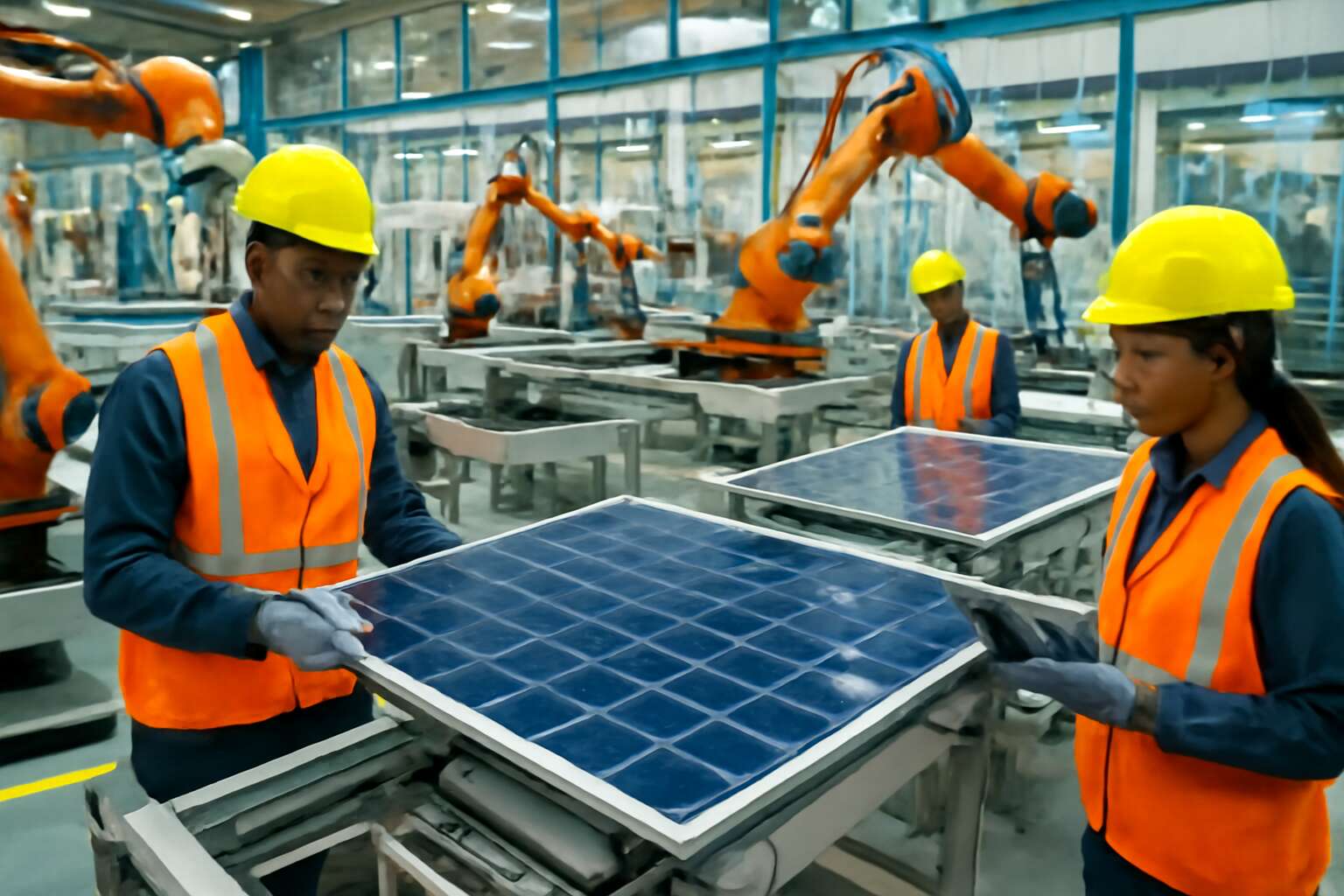
Current landscape of solar panel manufacturing in South Africa
Overview of the SA solar panel manufacturing sector
“The sun powers more than roofs; it powers a burgeoning blueprint of industry,” insists a factory manager in Gauteng. In the current landscape, solar panel manufacturing south africa sits at a crossroads of local know-how and imported components, weaving a narrative of resilience and refinement across corridors.
The sector blends established module assemblers with nimble SMEs, anchored by local content programs and demand from commercial, agricultural, and residential projects. Key dynamics include:
- Domestic assembly lines expanding to reduce import dependence
- Strategic partnerships with cell manufacturers and local distributors
- Skilled job creation in engineering, automation, and QA
Factories sing with automation and artisan care, and the rhythm lifts the industry! While logistics, incentives, and training tighten the weave of the supply chain, the solar panel manufacturing south africa story is becoming a chapter in a wider energy landscape, where the sun both sustains and sparks enterprise.
Leading companies and manufacturing hubs in South Africa
“The sun never negotiates,” declares a Gauteng factory manager, and that honesty now frames the current landscape of solar panel manufacturing south africa. Across the region, seasoned module assemblers stand beside automation-minded facilities, while nimble SMEs push local innovations that translate into faster turnarounds and tighter supply chains. The sun powers more than rooftops here; it powers a stubborn, refining economy.
Leading companies and manufacturing hubs anchor the sector, drawing on adjacent cell production, local distributors, and a robust after-sales ecosystem. These clusters include:
- Gauteng: centralized assembly and automation hubs
- Western Cape: research, testing, and packaging facilities
- Eastern Cape and KwaZulu-Natal: logistics corridors and regional assembly
These dynamics map a resilient arc: collaboration over isolation, and a quiet, steady push toward domestic content and export readiness.
Regulatory environment, incentives, and policy impact
“The sun is a policy accelerator,” a Gauteng factory regulator told me, and the line still hums in the corridors. The current regulatory engine guides solar panel manufacturing south africa with clear local-content goals, stable import rules, and predictable tender criteria, turning uncertainty into a strategic asset.
Incentives are a strategic windfall, nudging players to invest in local factories, testing labs, and assembly lines!
The policy mix fosters stronger supplier ecosystems and a faster domestic-to-export pipeline.
- Local-content targets in national procurement
- Accelerated depreciation and tax incentives for manufacturing facilities
- Development-finance grants and soft loans for equipment upgrades
As policy is steadier than sunlight, the sector watches each reform for its ripple effects on jobs, pricing, and resilience.
Industry trends, adoption rates, and market size in South Africa
For stakeholders in solar panel manufacturing south africa, the landscape is evolving as rooftop demand grows and utility-scale projects anchor a more diversified mix. Local installers report brisk demand across residential and commercial sectors, while new pilot lines push into mid-size modules. The result is a growth spurt across the supply chain, from cells and laminates to assembly, signaling a more resilient domestic footprint.
Here are the currents shaping the sector today:
- Rising local-content commitments strengthening supplier ecosystems
- Continued declines in solar component costs expanding affordable capacity
- Increased finance channels, including development funds and soft loans, fueling upgrades
Market size and adoption: While there is room to expand beyond major cities, the growth is becoming more inclusive with industrial campuses and municipal programs. Manufacturers are looking to regional opportunities, expanding service networks and spare parts. Export potential remains a key tailwind for capacity, even as domestic demand strengthens.
Materials and technology used in solar panel production
Silicon PV cell types and cell efficiency trends
Across South Africa, rooftop energy is rewriting daily life. In solar panel manufacturing south africa, global silicon know-how meets local ingenuity, pushing module output higher and costs down. Mainstream silicon cells now reach the mid-20s percent efficiency, powering homes and businesses with fewer hiccups!
Key materials and technology form the backbone of this craft.
- Silicon wafers: mono- or polycrystalline
- Passivation and anti-reflective coatings
- Metallization and back-contact designs
Silicon PV cell types have diversified beyond old standards. Monocrystalline PERC dominates, while TOPCon and HJT show higher gains at scale. Mass-produced cells sit in the mid-20s for efficiency, with lab breakthroughs nudging toward the high-20s—driving continued growth in the region’s solar sector.
Glass, encapsulants, backsheets and coatings
Rooftops across South Africa are turning into power plants, and rooftop PV installations are climbing in double digits year after year. In solar panel manufacturing south africa, glass, encapsulants, backsheets, and coatings fuse resilience with performance, letting daylight become steady electricity!
Key materials and technology include:
- Tempered front glass
- EVA encapsulants
- Polyester or PVF backsheets
- Anti-reflective coatings
These components endure SA climate, balancing cost and durability, while local supply chains push efficiency gains across the industry.
Encapsulation, lamination, and module assembly processes
Bright currents pass through layered glass and film—the quiet engine of solar panel manufacturing south africa. In this cradle of innovation, encapsulation, lamination, and module assembly turn daylight into durable performance. The cycle blends tempered front glass, EVA encapsulants, and backsheet substrates with precise heat and pressure to resist SA’s sun and sudden storms!
Encapsulation and lamination are the tight seam of reliability. Controlled vacuum and exact temperatures fuse cells into weather-hardened panels. In solar panel manufacturing south africa, the sequence unfolds in three acts:
- Pre-laminate alignment of cells and EVA sheets
- Lamination under vacuum to cure the encapsulant
- Cooling, inspection, and edge sealing
Finally, module assembly closes the loop: junction boxes, framing, and electrical tests ensure each unit travels from factory floor to rooftop under African skies. Local capability here translates into steadier power and sharper cost efficiency in solar panel manufacturing south africa.
R&D in local PV technology and innovation ecosystems
South Africa’s PV labs pulse with a stubborn optimism—the sun is a stern tutor, and R&D mirrors the country’s relentless edge. In this crucible, materials science travels from bench to pilot, guided by a quest for rugged performance under SA’s sun and sudden storms. It’s not only about efficiency; resilience, supply-chain trust, and long-lasting durability keep panels singing on roofs from Limpopo to the Cape.
Materials and technology in solar panel manufacturing south africa are evolving through local R&D ecosystems that knit universities, startups, and manufacturers into a living fabric. Here, researchers chase durable polymers, stable interlayers, and climate-hardy interfaces—local innovations designed to endure dust, heat, and humidity while keeping costs in check. These efforts convert climate into a catalyst for genuine industrial strength.
- Durable polymers and interlayers tuned for SA’s thermal cycles
- Advanced glass with anti-reflective microstructures to maximize captured light
- Locally developed recyclable laminates and adhesives to trim waste
This is more than technique; it’s a moral project where science meets daily life, turning measured risk into dependable power under African skies.
Quality control standards and testing protocols for SA manufacturing
Materials and technology are becoming a tangible bridge between research benches and assembly lines. The aim isn’t only higher wattage; it’s ruggedness—polymers, climate-ready interlayers, and glass engineered to shrug off dust, heat, and sudden storms. Local R&D translates lab performance into factory reliability, with traceable materials and transparent compliance shaping every module that leaves the line.
Quality-control standards and testing protocols are equally crucial, pairing international benchmarks with local expertise:
- In-line optical and visual inspection during lamination and encapsulation
- Electroluminescence (EL) and infrared (IR) thermography to detect microcracks and hot spots
- Environmental and mechanical stress testing aligned with IEC/ISO qualifications
In solar panel manufacturing south africa, standards and testing echo a blend of global rigour with local pragmatism, ensuring every unit endures SA’s climate.
Supply chain and manufacturing infrastructure in South Africa
Regional factory distribution and capacity planning
Across South Africa, solar panel manufacturing south africa hints at a quiet, enduring revolution. A single plant does not stand alone; it threads raw inputs, logistics, and skilled hands into a living lattice powering municipal grids and budding enterprises.
Regional factory distribution leans on local strengths: Gauteng accelerates design-to-market cycles; Western Cape and Eastern Cape host assembly lines near ports; KwaZulu-Natal anchors logistics with adjacent rail and harbor access.
- Regional supply chain visibility reduces downtime
- Modular capacity planning keeps lines scalable
- Energy reliability with on-site microgrids sustains throughput
Together, these threads form a resilient weave that keeps the industry humming, even as demand shifts with seasons and policy.
Local content, sourcing, and supplier networks
Local content rules are not mere compliance; they are a design principle in solar panel manufacturing south africa. The supply chain here threads local inputs with agile regional suppliers, turning procurement into a living partnership. When markets shift, the local network rises to meet demand, delivering reliability, faster turnarounds, and a shared commitment to community growth. The outcome is a steadier cadence for assembly lines and the grids they empower.
- Local content and supplier development programs
- Near-source materials and regional logistics hubs
- Transparent sourcing and robust quality control ecosystems
From Durban to Johannesburg, this tapestry is more than infrastructure; it is a human story—engineers, technicians, and craftspeople weaving skills into every module. This is resilience in motion—where local content meets global ambition.
Energy reliability, grid access, and impact on operations
South Africa’s grid beats to a variable rhythm, turning outages into production risk. Energy reliability and grid access shape every shift and module in solar panel manufacturing south africa. We blend on-site generation, smart demand management, and regional power routes to keep lines humming!
To bolster this resilience, the ecosystem centers on practical levers:
- On-site energy storage and demand management
- Diversified regional transmission corridors and microgrids
- Utility-backed reliability programs and long-term PPAs
These levers translate into steadier production schedules, faster ramp-ups, and a sturdier footprint for solar panel manufacturing south africa across the region!
Logistics, warehousing, and export readiness
South Africa’s logistics pulse moved roughly 1.2 million TEUs last year—a number that makes a warehouse smile. For solar panel manufacturing south africa, dependable transport corridors and port access aren’t optional luxuries; they’re the backbone that keeps production lines humming and shipments arriving on time.
Key levers include climate-conscious warehousing, near-port storage, and export-readiness processes that glide through customs.
- Strategic warehousing near ports and hubs
- Integrated inventory, tracking, and visibility
- Export documentation and compliance automation
Regional corridors and microgrids knit a resilient backbone for the solar sector, letting manufacturers scale up, diversify routes, and meet demand across the region with fewer bottlenecks.
Market dynamics, policy support, and growth opportunities
Demand segments: residential, commercial, and utility-scale in South Africa
South Africa’s energy landscape is shifting under the sun, and solar is leading the charge. Policy clarity and predictable incentives are acting as catalysts, nudging local manufacturers to expand capacity and tighten supply chains. “Policy certainty is the match that lights up the market,” says a veteran executive, and the impact is visible: demand now spans residential rooftops and utility-scale plants, widening the horizon for solar panel manufacturing south africa.
- Residential: rooftop retrofits and off-grid homes drive demand for compact, reliable modules and long-term warranties.
- Commercial: office parks, retail centers, and hospitality sectors seek durable PV systems with easy maintenance and strong local support.
- Utility-scale: IPP-driven projects push standardized, large-format modules and accelerated deployment across the grid.
Policy support, a growing local supplier network, and a push toward export-ready capabilities create a fertile growth corridor for South Africa’s solar manufacturing ecosystem.
Government programs, tariffs, and incentives for solar manufacturing
“Policy certainty is the match that lights up the market,” a veteran executive once said, and in solar panel manufacturing south africa, the flame grows brighter with each predictable policy update. Market dynamics are defined by steady demand, bankable procurement, and a rising confidence in local supply chains. Manufacturers are planning multi-year roadmaps, balancing currency risk with scale, and chasing modular, resilient designs that fit both compact rooftops and vast solar farms.
- Tariff structures that favor local content and domestic manufacturing investments
- Tax incentives and accelerated depreciation to support capex
- Export credits and project-backed subsidies to accelerate regional growth
Growth opportunities arise where government programs align with private investment: tariffs that safeguard jobs, incentives that shorten payback, and export-readiness initiatives that push SA modules onto regional grids. The flourishing ecosystem invites new entrants to scale into export markets while maintaining quality and service excellence.
Financing, investment climate, and risk factors
Market dynamics ride on double-digit growth in annual installations, a wind that longs for policy clarity. In solar panel manufacturing south africa, buyers chase predictable project cycles, bankable procurements, and a resilient local supply chain, enabling multi-year roadmaps that balance currency risk with scale and the pursuit of modular, scalable designs for rooftops and giant solar farms.
Policy support acts as a compass, smoothing the rough seas of capital and risk.
- Tariffs favoring local content
- Tax incentives and depreciation support
- Export credits for regional growth
Growth opportunities flourish where public programs align with patient private capital. A stable investment climate lowers the cost of debt, while careful risk management—currency hedging, diversified supply lines, and practical grid-readiness—keeps projects moving toward export-readiness and regional grid integration.
Export potential and regional trade considerations
Market dynamics in the energy transition are shaping a new rhythm for solar panel manufacturing south africa. Buyers demand predictable project cycles, bankable procurements, and a resilient local supply chain. Multiyear roadmaps for rooftops and utility-scale farms are becoming the norm, balancing currency risk with scale and modular design.
Policy alignment acts as a compass, smoothing the rough seas of capital and risk. Key levers include:
- Tariffs favoring local content
- Tax incentives and depreciation support
- Export credits for regional growth
Growth opportunities rise where public programs pair with patient private capital. Export potential grows as regional trade corridors extend across SADC markets, encouraging regional assembly and cross-border supply chains that feed into grid-ready projects and shared manufacturing ecosystems.
Future outlook: scalability, job creation, and competitive advantages
“Sunlight isn’t a short-term bet,” a regional energy strategist quips, and the data backs it up. Market dynamics show demand for predictable cycles and bankable procurements. The solar panel manufacturing south africa sector is aligning with multiyear roadmaps for rooftops and utility-scale farms.
Policy levers — tariffs that favor local content, depreciation incentives, and export credits — smooth capital flow and reduce risk, letting local suppliers scale with confidence.
Growth opportunities rise when public programs meet patient private capital. Across SADC corridors, regional assembly and cross-border supply chains feed grid-ready projects.
- Regional assembly and cross-border supply chains
- Shared manufacturing ecosystems and skill development
- Bankable pipeline for rooftop and utility-scale projects
Future outlook: scalability, job creation, and competitive advantages for South Africa’s solar panel manufacturing.


0 Comments