
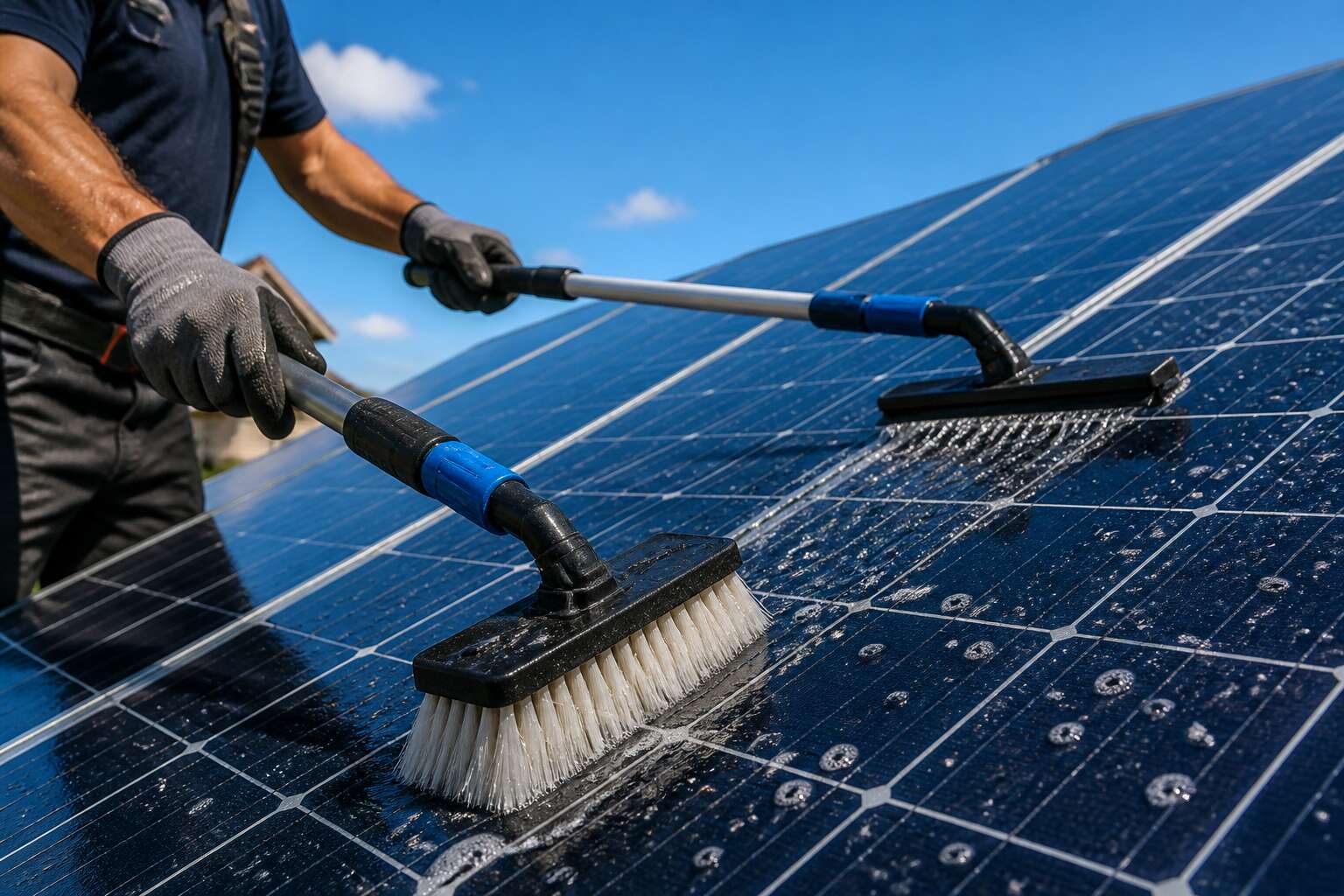
Key Factors That Shape Service Pricing
How Geographic Location Affects Rates
The true measure of a solar panel cleaning cost is not a simple number. It is a spectral sum of labour, water, and the silent geometry of your roof. Service pricing shifts on accessibility, panel count, and the stubborn mineral film from borehole or municipal water. Consider the elements that weigh on the final figure:
- Roof pitch and tilt, which complicate harness work.
- Water pressure and purification equipment required on site.
- Distance from a service depot, which burns fuel and time.
Geographic location wields the heaviest hand in South Africa. In arid regions like the Karoo, dust storms conspire to darken your panels weekly. Coastal towns like Cape Town demand more frequent washes for salt spray. Urban rates in Johannesburg often carry a premium for traffic and scaffolding. The solar panel cleaning cost rises with every kilometre of red dust between you and the crew.
Roof Complexity and Panel Accessibility
A rooftop is a geometry of angles and obstacles. Steep pitches force crews to rig safety lines, which adds time. Fragile clay tiles demand careful foot placement, slowing every pass. Solar panel cleaning cost is not a flat rate; it is a reflection of how hard the roof works against the cleaner.
- Low clearance between panel rows, which traps dust and makes brushing awkward.
- Skylights and vents that interrupt the array, requiring manual handling.
- Weak anchor points for harnesses, which mean extra equipment on site.
Each obstacle compounds labour. A straightforward single-storey roof with easy access will always price lower than a multi-tiered installation with tight corners. The true solar panel cleaning cost emerges only after assessing these physical hurdles.
System Size and Total Panel Count
System size dictates the arithmetic of effort. A modest residential array of eight panels asks for an hour of careful wiping; a sprawling commercial field of three hundred demands a full day. The solar panel cleaning cost scales almost linearly with the number of modules, though not quite. Every additional panel introduces another junction, another edge where grime collects.
- Long continuous rows allow faster work than scattered clusters.
- High panel counts require more water and more cleaning solution.
- Multiple inverters and cable runs add time to every visit.
Logistics multiply with each module. Water supply, hose reach, the volume of solution, the number of times the technician climbs down and repositions the ladder. In our work across South African rooftops, systems often grow incrementally as budgets allow. The solar panel cleaning cost follows that growth, because each module collects its own dust and requires its own labour.
Service Frequency and Recurring Discounts
Service frequency bends the price in ways that surprise people. A once-off clean carries the full cost of mobilisation, because the technician brings everything for a single visit. Recurring contracts spread that overhead across multiple jobs, so the solar panel cleaning cost drops noticeably.
In South Africa, where dust and bird traffic show up with personality, most clients settle into a rhythm. The dirty panels arrive faster than you expect. That rhythm matters:
- Monthly visits keep grime from building a foundation.
- Quarterly schedules work for areas with light pollution.
- Bi-annual cleanings suit rainier regions.
Locking in a recurring service also earns discounts. Providers price the solar panel cleaning cost lower when they know the work repeats. It is simpler for them and kinder to your pocket.
Extras Like Inspections or Minor Repairs
Beyond the visible grime, a technician often uncovers issues that complicate the solar panel cleaning cost. I have seen invoices climb when panels need torque checks on their mounting brackets, or when a voltage drop appears across a string. These extras are not upsells; they are diagnostic realities.
Inspections typically involve thermal imaging or IV curve tracing. Each adds labour and equipment time. Minor repairs, such as resealing junction boxes or replacing a damaged MC4 connector, introduce parts cost. Some providers bundle a visual inspection into the service price. Others list it separately.
- Thermal scanning adds roughly 15 percent to the base quote.
- Replacing a single connector runs between R150 and R350.
- Bird proofing mesh adjusts the quote upward, but protects the array.
The solar panel cleaning cost therefore covers more than the wash itself. Ask for a written breakdown before you commit!
Average Prices for Professional Cleaning
One-Time Cleaning Service Fees
A single dirty panel can reduce output by 20%, yet the solar panel cleaning cost rarely makes the headlines. In South Africa, professional crews charge between R350 and R900 for a one-time cleaning service fee on a standard residential array. That price covers labour, water, and basic detergent, but excludes specialized chemicals or high-pressure equipment. Most companies quote a flat rate after a quick site assessment.
Consider these common price points:
- Basic rinse with tap water: R350 to R450
- Standard wash with soft brushes and biodegradable soap: R450 to R650
- Premium service using deionized water and telescopic poles: R650 to R900
One-time fees also depend on how long since the last wash. I’ve noticed a lightly dusty array takes less time than one caked with bird droppings or mineral deposits. The true solar panel cleaning cost reflects the patience required for a flawless finish.
Recurring Plans and Subscription Packages
Weather alters panel performance faster than most owners expect. A subscription plan transforms the solar panel cleaning cost from an unpredictable expense into a steady monthly line item. In South Africa, recurring contracts often reduce per-visit rates by 15% to 25%. My own quarterly arrangement costs R550 per clean for a six-panel system, compared to R700 for a single booking.
Most suppliers structure packages around frequency:
- Monthly visits for dusty regions: R300 to R450 per session
- Quarterly standard: R450 to R600 per session
- Bi-annual deep clean with inspection: R650 to R800 per session
These plans include travel and basic detergent. The real value sits in scheduling priority; a subscriber’s panel never waits two weeks for a slot. Thus, the solar panel cleaning cost stabilizes, and system efficiency remains predictable.
Residential vs. Commercial Rate Comparison
Commercial arrays carry a different price logic entirely. While a residential quote might hinge on panel count, commercial contracts hinge on square metres and access equipment. The solar panel cleaning cost for a single-storey home in Johannesburg often lands between R450 and R700. A warehouse rooftop, by contrast, might run R1,200 to R1,800 per visit, simply because the crew needs lifts and safety protocols.
Rate comparison reveals a paradox: per-panel, commercial cleaning is cheaper. Bulk scale drives the unit price down, even as the total invoice climbs. For example:
- Residential, 8 panels: R550 to R850
- Commercial, 100 panels: R4,500 to R6,000
Yet commercial clients rarely book single cleanings. They negotiate monthly schedules, which pushes the solar panel cleaning cost per square metre down further. The real gap isn’t the sticker price. It’s the operational complexity hiding inside each quote.
Per-Panel Pricing vs. Hourly Charges
The solar panel cleaning cost in South Africa is seldom a single number. Professional crews quote per panel for routine jobs, but switch to hourly rates when access becomes a puzzle. That shift matters because a quoted price can exclude time based extras.
Per-panel pricing dominates standard rooftops. An 8 panel array lands between R550 and R850, which breaks down to roughly R70 per module. Hourly charges appear for homes with steep tiles or complex mounting systems. Crews often bill R350 to R550 per hour, with a one hour minimum. Here is what drives the rate upward:
- A second technician adds R150 to R200 per hour.
- Pure water equipment and pole systems run a premium.
- Travel time to outlying suburbs gets folded into the quote.
When you request a price, ask whether the solar panel cleaning cost is fixed or time based. Otherwise you may pay for indecision, not dust.
Comparing DIY Cleaning and Professional Services
Initial Investment in Cleaning Equipment
In South Africa, sunlight is abundant, but grime is equally relentless. The true expense of cleaning lies in the tools you choose.
For the committed homeowner, a DIY arsenal demands a serious initial outlay. Deionized water systems, telescopic poles, soft brushes, and maybe a roof harness. These items cost more than one professional visit, yet they serve for years.
- Deionized water filtration unit
- Carbon fiber telescopic pole
- Rotating soft brush head
- Safety ladder and roof anchor
That equipment budget reshapes your calculation. Comparing upfront spend against per service fees, the solar panel cleaning cost becomes a cash flow matter. Professionals absorb their own capital expenses, charging you only for the result.
Safety Risks and Potential Damage Costs
A single misstep on a tiled roof can turn a R500 saving into a R15,000 hospital bill. The solar panel cleaning cost discussion often ignores this reality. DIY enthusiasts face slip risks, structural damage to roofing, and the possibility of cracking panels with poor pressure handling.
Professionals carry liability insurance and use harness systems. That coverage matters because one cracked photovoltaic cell can cost more than five years of service fees.
- Replacing one broken panel: R2,500 to R4,000
- Roof tile repair after a fall: R800 to R1,500
- Emergency room visit: R3,000 to R20,000
The initial equipment investment pales when compared against these outcomes. Any honest audit of solar panel cleaning cost must factor in worst case scenarios, not just the quoted service fee.
Cleanliness Quality and System Performance
DIY cleaning often leaves a faint film of minerals and grime behind. Municipal water in South Africa contains dissolved solids that dry into a chalky residue, which blocks sunlight after washing. Professional services use deionized water and soft brushes, removing the film entirely. Monitoring data shows a professionally cleaned array can regain up to 5% more yield than a DIY tap water wash.
- Streaking from hard water on tilted panels
- Micro-scratches from gritty cloths or sponges
- Missed corners where dust accumulates and bakes on
That residue accelerates soiling over time. The solar panel cleaning cost of frequent DIY attempts may match a professional visit, while delivering inferior system performance. I have seen the difference in kilowatt output become obvious within a week. When you factor in the solar panel cleaning cost against the yield you sacrifice, the professional service makes sense.
Time Commitment vs. Convenience Factors
Every hour spent balancing on a ladder is an hour you are not watching your own yields. Consider the full routine: hauling hoses, mixing solutions, waiting for panels to cool, scrubbing each row twice because the first pass left streaks.
- Setting up the ladder safely on uneven ground
- Dragging extension cords and water lines around the roof
- Repeating awkward reaches on high-tilt installations
A professional crew arrives with their own water, their own ladders, and their own insurance. You hand over a key or a gate code, and ninety minutes later the system is clean. The solar panel cleaning cost covers that convenience, which matters when your available hours are scarce and your roof is steep. What a relief it is to spend that afternoon doing anything else.
Strategies to Lower Your Service Expenses
Combining with Solar Maintenance Contracts
Bundling cleaning with a maintenance contract shifts your solar panel cleaning cost from a variable burden into a predictable line item. Many South African homeowners overlook this option. A single annual service, scheduled alongside inverter checks and bracket tightening, often costs 15% less than separate callouts. Consider what a contract typically bundles:
- Routine panel washing and debris removal
- Electrical connection torque checks
- Annual performance report
That combined approach means you pay one technician for one efficient visit. You avoid the surprise of emergency repairs after months of neglected dust. The solar panel cleaning cost becomes part of a fixed budget, not a reactive expense. And because the technician already knows your system’s layout, the cleaning takes less time than a first-time visit. For a typical 12-panel home in Johannesburg, this can save you nearly enough to cover a year of monitoring fees.
Timing The Clean for Seasonal Promotions
Timing your clean for seasonal promotions can lower your solar panel cleaning cost. In South Africa, service providers often discount their rates during leaner months, such as late autumn or early spring. Demand dips after the summer heat and before the winter rains, so companies compete for bookings.
I have seen homeowners wait for a winter special and save enough to cover an inverter check. These promotions appear because of predictable patterns in the solar industry.
- Reduced demand for cleaning during school holidays
- Overlapping schedules with routine maintenance drives
- Weather forecasts that clear the calendar for several days
The seasonal timing of your appointment affects the final solar panel cleaning cost. A midweek slot in September often carries a lower price than a Friday in January.
Water Conservation and Eco-Friendly Techniques
A single roof wash can consume 200 litres of municipal water. South Africa’s water constraints have forced the solar industry to adapt, and that adaptation now works in your favour. Many reputable cleaning teams use deionized water or dry brushing techniques, which slash water usage dramatically. These methods protect local reserves and often reduce the solar panel cleaning cost because the job needs less equipment and shorter setup time.
Ask a provider what their eco-friendly service actually includes:
- Soft brush and squeegee systems that use minimal water
- Biodegradable cleaning solutions safe for your garden and tank
- Mobile units fitted with water recycling tanks
A company that carries its own water avoids tapping into your supply. That spares you the headache of monitoring usage and keeps the solar panel cleaning cost predictable. Teams using telescopic poles instead of ladders also cut labour time, which trims the final invoice without cutting corners on performance.
Requesting Multiple Quotes and Negotiation Tips
The solar panel cleaning cost varies wildly between providers. One quote might be double another for identical work. That gap is not random. It reflects who wants your business and how badly.
Request at least three quotes. Ask each company for a breakdown, not a lump sum. You want to see labour, equipment, and travel charges separately. A cheap quote that hides extras becomes expensive later.
- Compare per-panel pricing against hourly rates
- Ask about travel fees for your suburb
- Confirm whether biodegradable solution costs extra
Negotiation works when you have numbers. Tell a provider you have a lower offer. Ask if they can match it or include a free inspection. Many will adjust. The solar panel cleaning cost drops when you show you are ready to walk away.

0 Comments