GridVolt Energy Solutions is a Solar energy company establishment in Gqeberha, Eastern Cape, South Africa
GridVolt Energy Solutions is an independent solar energy company serving the Eastern Cape, with offices in Port Elizabeth, Queenstown and East London. Established in 2019, the company concentrates on residential and mid-commercial energy solutions, specialising in hybrid and off-grid configurations. The organisation emphasises a consumption-driven design approach, aiming to invest capital where it delivers the strongest financial return while ensuring a stable and reliable energy supply for its clients.
The firm operates as an engineering-led team that includes engineers, electricians and analysts. It holds professional credentials and affiliations including PV Green Card accreditation, registration with the Electrical Contractors Association and recognition by the Department of Labour. These accreditations underpin GridVolt’s emphasis on safety, compliance and professional installation practices across the Eastern Cape region.
GridVolt’s core services span residential and commercial solar installations, with a clear focus on helping customers reduce carbon footprints and promote energy independence. On the residential front, the company markets a range of solar packages designed for varying household needs and budgets. Key offerings feature back-up hybrid systems and solar-ready configurations, all designed to integrate clean energy with existing electrical infrastructure. The firm markets a progression of 5 kW and 8 kW systems, along with higher-capacity options that combine inverters, lithium-ion battery storage and solar photovoltaic (PV) panels. Each package aims to deliver long-term performance with a 10-year warranty on major components.
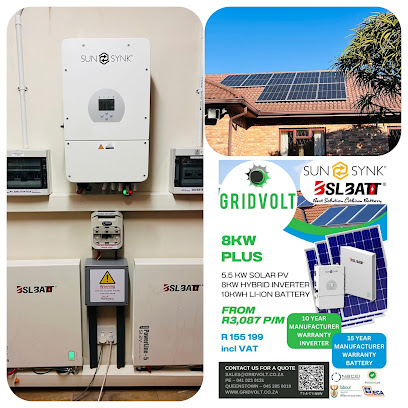
For homeowners seeking back-up power, GridVolt offers 5 kW and 8 kW hybrid inverter solutions. The 5 kW option includes a 5 kWh lithium-ion battery and a 10-year warranty, while the 8 kW system expands to a 10 kWh battery. In common with the broader residential line, these solutions are described as solar-ready, enabling straightforward integration with PV panels and energy storage for more resilient power supply during load shedding or grid interruptions.
In the higher end of the residential market, GridVolt provides 5 kW and 8 kW solar solutions featuring larger battery capacities and higher solar PV sizes. Packages are presented with transparent monthly and one-off pricing, illustrating potential affordability across different consumer segments. Packages are advertised as “Popular Packages” and “Pro” or “Plus” variants, highlighting scalable options for varying energy demands and budgets. A consistent theme across residential communications is the promise of reliable energy supply, cost savings, and ongoing support.
Commercial solar packages extend GridVolt’s capabilities into business contexts. Available configurations include 50 kW and 100 kW systems, with multi-pack options such as Hybrid UPS variants. These commercial packages emphasise higher power capabilities and larger energy storage arrangements, reflecting the needs of businesses to cut electricity bills and maintain operations under diverse load profiles. Notable package configurations feature three-phase hybrid inverters and substantial battery storage, paired with solar PV capacity designed to optimise performance and return on investment.
How requests typically work is presented through an accessible contact process. The site indicates that interested clients can submit a number via a form to request a callback, enabling GridVolt to initiate a consultation and site assessment. The “Need a call?” element appears consistently across pages, reinforcing the company’s approach of guiding clients from initial inquiry to customised solar solutions. Contact details for the Port Elizabeth, Queenstown and general sales lines are provided, along with an email address, ensuring multiple channels for client communication.
Customer experience, as reflected in visitor feedback, generally highlights professionalism, strong installation standards, and high levels of after-sales support. Reviews describe projects completed efficiently with tidy work practices, friendly teams, and helpful ongoing support, including assistance with tariff changes and energy savings. Clients frequently cite prompt responses, clear explanations of options, and good preparation in aligning system configurations with specific needs. Several reviews also note that installations enabled reliable power, reducing dependence on Eskom and improving business continuity or household resilience.
Practical tips for potential customers include: begin with a consumption analysis to identify the right size and type of system; prioritise a solution with a 10-year warranty on major components and a contingency warranty such as a 48-hour swop-out for rapid problem resolution; ensure compatibility with existing electrical systems and any tariff arrangements; and consider the value of including energy efficiency measures alongside solar PV to maximise savings. Prospective clients should also verify service coverage within the Eastern Cape and confirm project timelines, site readiness and any required permits in advance of installation.
GridVolt serves residential and commercial clients across the Eastern Cape, with explicit focus on Port Elizabeth, Queenstown and East London. The combination of accredited engineering expertise, customer-centred service and a broad package range positions GridVolt as a notable option for organisations and households seeking sustainable, resilient solar energy solutions in the region.
- Main services offered: residential solar packages (including 5 kW and 8 kW back-up and solar solutions) and commercial solar packages (50 kW and 100 kW configurations with Hybrid UPS options).
- Typical job types: residential home installations, small to mid-sized commercial solar deployments, hybrid and off-grid configurations, and solar PV system upgrades or replacements.
- How requests work: initial inquiry via form to request a callback, followed by consultation and customised system design.
- Practical tips: perform consumption analysis, look for a 10-year warranty, request a rapid swop-out option, ensure solar readiness, and confirm local service coverage in the Eastern Cape.
Gqeberha
Eastern Cape
South Africa
Sorry, no records were found. Please adjust your search criteria and try again.
Sorry, unable to load the Maps API.
Solar energy services in Gqeberha, Eastern Cape
In the coastal city of Gqeberha, Eastern Cape, solar energy providers typically offer a range of services designed to help businesses and households shift towards sustainable electricity. The focus is on practical, solutions‑based systems that make use of the local climate, available roof space, and the appetite for reliability in a region known for its sunny days. An independent installer is often consulted to determine the most appropriate configuration, whether that means grid‑tied, hybrid, or off‑grid arrangements.
Initial assessments commonly begin with a site survey and load evaluation. A skilled technician will review electrical consumption patterns, peak demand, and potential load changes over time. This helps determine the size of the solar array, the number and type of photovoltaic panels, and the capacity of the energy storage and balance of system components. The process typically includes an assessment of roof condition, orientation, shading from nearby structures, and the best placement for modules to maximise exposure to sunlight throughout the year.
Design and design‑build services are geared towards creating a customised solar solution that aligns with local grid requirements and building regulations. Plans usually cover the electrical layout, mounting framework, conduit routes, and protection measures such as earthing and surge protection. In regions like the Eastern Cape, where weather patterns can be variable, engineers may emphasise durability, corrosion resistance, and ease of maintenance when selecting hardware suitable for coastal humidity and occasional heavy rain.
Installation services generally involve mounting photovoltaic modules on rooftops or ground stands, wiring into an inverter system, and integrating with the building’s electrical system. Inverter equipment is selected to convert DC power into usable AC power, with attention to efficiency, safety features, and compatibility with battery storage if a hybrid or off‑grid setup is desired. The installer will typically handle commissioning which includes performance testing, safety checks, and ensuring compliance with local electrical standards.
Storage and energy management are central themes for many customers in the region. Battery storage options provide resilience during power cuts and allow greater self‑consumption of daytime solar to offset evening usage. In a hybrid configuration, battery banks can charge from solar during the day and supply power when the sun is not shining, while still maintaining a connection to the main grid for reliability. For those pursuing a completely off‑grid solution, supplementary systems such as backup generators or advanced monitoring may be included to guarantee continuity of electricity supply.
Maintenance and monitoring services help ensure long‑term performance. Routine inspections, cleaning of panels, and checks on electrical connections are common components. Remote monitoring may be offered to track energy production, consumption, and storage status, enabling prompt detection of anomalies and facilitating efficient system management. Warranties and service agreements typically cover equipment performance and response times for repairs or replacements.
Practical considerations for clients in Gqeberha include permitting and compliance with building and electrical regulations, as well as coordinating grid interconnection where applicable. Some projects may require liaison with the local municipality or electricity distributor to authorise net metering or grid‑tie arrangements. Local climate, humidity, and potential salt exposure near coastal areas can influence material choices and maintenance schedules, leading to a preference for robust, corrosion‑resistant components and protective enclosures.
Costs and financing options are discussed in a transparent early stage, with explanations of payback periods, expected energy savings, and any available incentives or rebates. While exact figures vary, the emphasis remains on delivering dependable, scalable systems that fit a property’s energy profile. Across Gqeberha, customers can expect a pragmatic approach that prioritises safety, reliability, and clear communication from assessment through to aftercare.
- Site assessment and load analysis
- System design for grid‑tied, hybrid, or off‑grid configurations
- Panel installation and electrical integration
- Battery storage and energy management
- Commissioning, testing, and safety checks
- Maintenance, monitoring, and warranty support