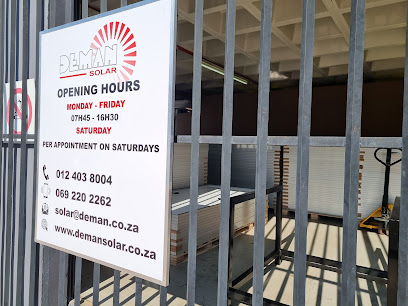
Deman Solar is a Solar energy company establishment in Pretoria, Gauteng, South Africa
Pretoria
Gauteng
South Africa
Sorry, no records were found. Please adjust your search criteria and try again.
Sorry, unable to load the Maps API.
Solar Energy Services in Pretoria, Gauteng
In Pretoria, Gauteng, solar energy providers offer a range of services aimed at enhancing energy independence and reducing electricity costs. The typical offering covers assessment, system design, installation, commissioning, and ongoing maintenance. Given the region’s climate and high daytime sunshine, installations often focus on rooftop photovoltaic (PV) systems tailored to individual premises, whether residential, commercial, or light industrial in nature.
Initial assessments usually involve a site survey to understand roof orientation, shading, and electrical capacity. Prospective customers can expect a professional to determine the size of the PV array, battery storage options, and any required inverters or safety equipment. The goal is to arrive at a solution that balances up-front costs with long-term savings and grid compatibility. In many cases, the assessment also considers load profiles, whether the aim is to offset daytime usage, provide resilience against outages, or support enterprise-level energy management strategies.
Design arrangements typically address multiple factors. System layout includes the number and placement of solar modules, inverter specification, and wiring routes. For premises with limited roof space or higher energy demands, combinations of solar panels with battery storage may be proposed to enable daytime charging and evening use. In commercial projects, consultants may also explore energy performance monitoring, sub-metering, and potential future expansion. All designs are crafted to meet local electrical standards and safety requirements, with attention to rain, hail, and other weather-related considerations common to Gauteng.
Installation services focus on safety, compliance, and durability. Qualified technicians install mounting structures, solar modules, electrical cabling, inverters, battery modules (where applicable), and protection devices. The process generally includes wiring for connection to the property’s electrical system, testing for proper function, and ensuring that safety features such as isolators and rapid shut-off mechanisms are in place. Post-installation commissioning verifies system performance, monitoring capabilities, and adherence to regulatory norms. Some projects may require coordination with the local municipality or utility in order to align with grid interconnection rules or feed-in policies.
Maintenance and aftercare form an important component of solar energy services. Regular inspections, cleaning of modules, performance reporting, and inverter firmware updates help sustain efficiency and reliability. Preventative maintenance can identify issues such as microcracks in panels, loose connections, or degraded components before they impact output. In larger, business-oriented systems, service agreements may cover remote monitoring, fault response times, and parts stocking to minimise downtime during troubleshooting.
Practical considerations for customers in Pretoria include the typical climate and the region’s daytime solar exposure, which generally favours grid-tied systems that maximise daytime generation. Some users may evaluate the benefits of incorporating batteries to improve resilience during outages or to capture excess solar production for later use. Financing options vary, ranging from upfront purchases to rental or power purchase agreements, with varying implications for long-term savings and maintenance responsibilities. Local support is often a key factor, with many providers offering regional knowledge about electrical permits, municipal requirements, and warranty conditions.
When engaging a solar energy company, clients can expect a clear, itemised proposal, a realistic timeline, and transparent discussion of potential savings and payback periods. Educational guidance commonly accompanies technical details, enabling customers to understand how the system integrates with existing electrical infrastructure, how monitoring data can be interpreted, and what to expect regarding performance through different seasons. The end result is a customised solar solution designed to suit the specific energy needs of Pretoria properties while contributing to broader environmental and economic goals.